
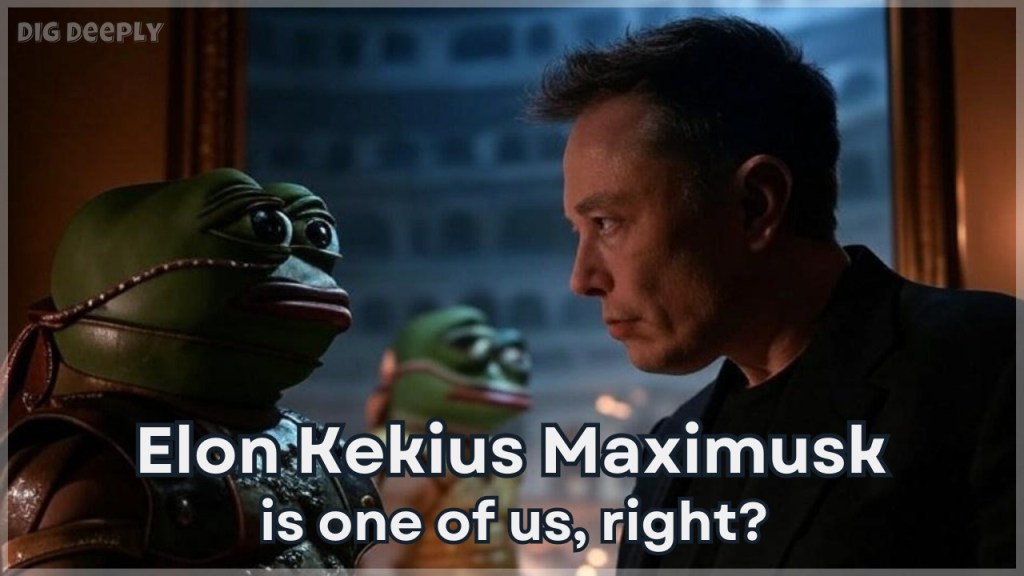
What do Pepe the Frog, Kek – the Egyptian god of darkness and chaos – and Maximus Decimus Meridius have in common? At first glance, perhaps not much, but if you take a closer look, you’ll notice that each of them, in their own way, has become a symbol of chaos, resistance, and a touch of meme magic. Sounds crazy, doesn’t it?
Pepe the Frog, started out as a harmless cartoon and became a symbol for everything from ironic humor to rebellious chaos thanks to the wild meme culture of the internet. He’s like the chameleon of pop culture: sometimes cute, sometimes provocative, but always somehow present when things get chaotic.
And then there’s Kek, the ancient Egyptian god of darkness. You might be thinking, „How does an ancient frog god fit into this story?” Well, thanks to the internet community and their boundless creativity, Kek was essentially resurrected. When gamers spread „kek” (an alternative way of saying „lol”) in their chats and discovered that Kek is also an Egyptian god, it was clear: Kek became the unofficial patron saint of the absurd online chaos community. And honestly, who wouldn’t worship a frog god for some epic mischief?
But what does Maximus Decimus Meridius – the steadfast gladiator and Roman general – have to do with this? Well, Maximus is essentially the OG rebel. With his legendary speech, „Are you not entertained?” he symbolizes the fight against a corrupt system and the determination to steal the show despite all odds. And, as befits a pop culture icon, his story was immortalized in meme form. Just like that, he’s earned his place among the legends of chaos!
What connects these three is their unintended rise as cult figures. They are more than their origins – Pepe, Kek, and Maximus have become symbols of the power of meme culture, resistance, and the sheer joy of total chaos. A little bit of chaos, a little bit of magic, and voilà: the trio you never saw coming!
What do these three have to do with terms like „creative destruction” and „Build Back Better”? At first glance, you might think: absolutely nothing, right? But hold on! If you take a closer look, you’ll realize this trio is practically made to embody these very ideas: chaos, transformation, and building something better. Sounds wild? Let me explain!
The concept of creative destruction is as old as time itself: sometimes, you have to tear down the old to make way for innovation and progress. And who could symbolize this better than Pepe, Kek, and Maximus?
Pepe the Frog shows us how creativity through destruction works. The harmless cartoon frog was reinterpreted, appropriated, and recycled by meme culture so many times that his original meaning was practically erased – only to be reborn in countless new forms. Chaos? Definitely. Innovation? Absolutely!
Kek, the Egyptian god of darkness, embodies exactly that: In mythology, darkness brings the transition to creation. In the meme world, Kek is revered as an ironic deity that emerged from pure chaos and absurd humor. A forgotten frog god suddenly becomes the mascot of the internet – that’s creative destruction in its wildest form!
And then there’s Maximus Decimus Meridius, our gladiator of upheaval. He challenges the corrupt Roman Empire and shakes the system to its core. Sure, a lot gets destroyed in the process – including himself – but his rebellion plants the seed for something new, something more just. Creative destruction? 100 percent.
And this is where „Build Back Better” comes into play: After the storm, after the chaos, it’s not about going back to the old ways – it’s about rebuilding something new and better.
Pepe has undergone countless transformations, from a cute cartoon frog to a global symbol of meme culture and ironic subversion. No matter how many times he’s been destroyed, he always comes back – sometimes funnier, sometimes weirder, but always better than before.
Kek teaches us that from chaos, opportunities arise. A god of darkness who becomes the patron saint of absurd creativity in the modern world? That’s so „Build Back Better” it almost hurts.
Finally, Maximus, with his sacrifice, sparks the rebuilding of a better Rome. He’s the guy who lays the groundwork for change – the prototype of a new beginning.
Pepe, Kek, and Maximus show us that chaos isn’t the end, but often the beginning of something new – and that sometimes, you have to destroy a little to build something truly great. This trio is proof that from chaos can come not only order, but one hell of a story. So, when life gets chaotic: Remember, you might just be in the phase where you’re shouting „Build Back Better”.
When the richest man in the world, who is also a influential advisor to the president of a global superpower, suddenly calls himself „Kekius Maximus”, it becomes a highly intriguing phenomenon with many layers.
By adopting this name, our billionaire signals: „I’m part of the game. I understand the jokes of the internet generation. And I use them to convey my messages.” It’s an invitation to the digital meme community: „Come on, let’s troll the system!”
The man wants to show: „Hey, I’m like you. I get the joke!” It’s as if he’s saying: „I have the power, and I’m going to creatively dismantle the existing system.”
It could be a subtle message to the powerful: „I’m not just a wealthy advisor – I’m a gamechanger.”
But what’s behind it – is he serious, or is he just playing around? In today’s world, where the lines between politics, business, and entertainment are increasingly blurred, it could be both. Maybe he’s simply trolling because he can. Or perhaps it’s a form of propaganda, subtly communicating his vision for change.
But one thing is certain – when someone with this kind of power calls themselves „Kekius Maximus”, it’s a statement – whether it’s meant to be humorous or strategic. It signals that the rules of the game are changing. Meme culture, once a harmless hobby for internet nerds, is now a tool in the hands of the powerful. And when Kekius Maximus is at the wheel, we can be sure of one thing: it’s going to be chaotic, it’s going to be entertaining – and maybe a little bit terrifying.
Ladies and gentlemen – please welcome the incomparable Elon Musk, aka Kekius Maximus.
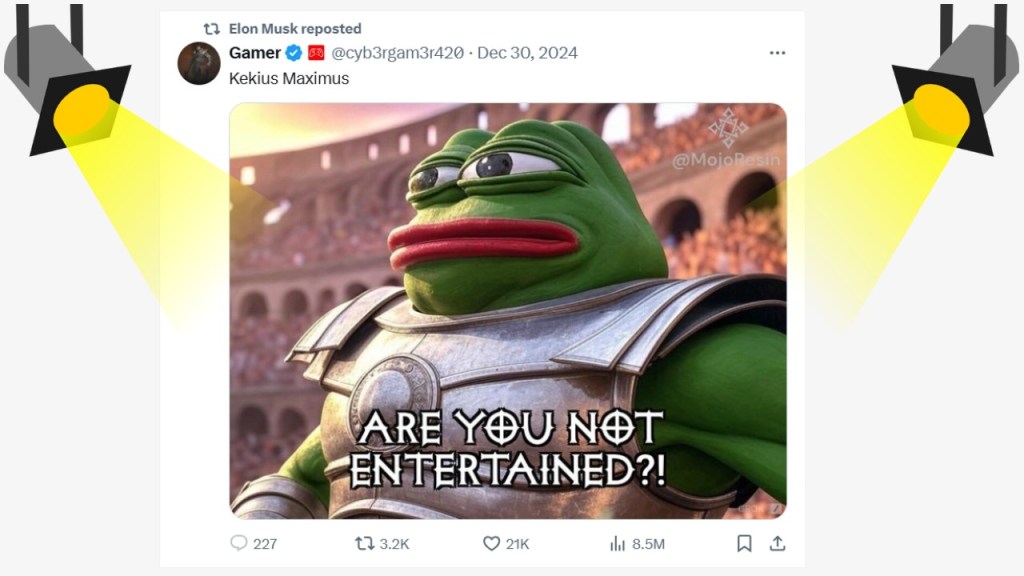
(Source X: https://x.com/cyb3rgam3r420/status/1873853864962846843)
It’s an absolute blast – at once fascinating, provocative and, in typical Musk fashion, a thoroughly calculated move.
Is he part of the chaos or its master? Is he fighting for change by bringing creative destruction – whether in the automotive industry, space exploration, or social media? Can he really be „one of us” and still be the boss?
And what about you, politicians and elites – do you perhaps take yourselves too seriously while he influences the game with an ease that leaves you speechless? Does the chaos of memes end up having more power than you want to admit? Does the new world really belong to those who speak the language of the internet?
Is he the architect of chaos – or the architect of progress?
It’s a fascinating move. And while the media are scratching their heads – wondering whether he’s just provoking or sending a deeper message – and speculating on what his true goal might be, we ask the simple question: WHO is Elon Musk?
Let’s first hear from Elon himself:
„I think one aspect of whatever condition I had was that I was just absolutely obsessed with truth. The obsession with truth is why I studied physics, because physics attempts to understand the truth of the universe. Physics is just what are the provable truths of the universe, truths that have predictive power. So, for me, physics was a very natural thing to study. Nobody made me study it. It was intrinsically interesting to understand the nature of the universe. And then, computer science, or information theory, also to just understand logic. There’s an argument that information theory is actually operating at a more fundamental level than even physics. So, physics and information theory were really interesting to me.” [TED-Interview, 14. April 2022]
(Source X: https://x.com/ElonClipsX/status/1874785186384101701)
„You want to be careful of these things where you wish for something that sounds good, but if you get it, it’s actually a dystopian situation. You could run a hypothesis, like if you wish for world peace, it sounds good, but how is it enforced? At what cost, eternal peace? It might actually be worse to have eternal peace, because of what that would entail. It might be the suppression of progress. It might be an ossified society that never changes. There is an argument that, if you wish for no war, you should be careful what you wish for because what’s required in order for there to be no war might be worse than a little war.” [Lex Fridman Podcast, November 2023]
(Source X: https://x.com/MarioNawfal/status/1873705582877691908)
„We generally operate with too much of an assumption that civilization is robust and nothing could really take it down. This sentiment has been common among empires shortly before they crumble. There’s a little bit of late-stage-empire vibes right now.” [WSJ, CEO Council, Mai 2023]
(Source X: https://x.com/ElonClipsX/status/1873659651625296140)
„What we’re not going to do is say that there’s some anointed class of journalists who are the special ones who get to tell everyone what they should think. It should be up to the people what they think. And even if an article is completely accurate, comprehensive, and everything, in writing that article, the media is choosing the narrative. They’re deciding what to write an article about. So, I’m hopeful that this can be more a case of the public choosing the narrative as opposed to the media choosing the narrative. At least a combination of the media and the public choosing the narrative, and the public getting to weigh in on stories if they think that they should add something to it, or we’ve got something wrong. And over time, I think if Twitter is the best source of truth, it will succeed. And if we are not the vessels of truth, we will fail.” [Interview with the BBC, April 12, 2023]
(Source X: https://x.com/ElonClipsX/status/1870477764291387476)
„Over time, we want Optimus to be the kind of android that you’d seen in sci-fi movies like Star Trek: The Next Generation, like Data. But, obviously, we could program the robot to be less robot-like and more friendly. And it can obviously learn to emulate humans and feel very natural. As AI in general improves, we can add that to the robot. It should obviously be able to do simple instructions or even intuit what it is that you want. So, you could give it a high-level instruction, and then it can break that down into a series of actions and take those actions.” [Tesla AI Day, 30. September 2022]
(Source X: https://x.com/ElonClipsX/status/1871108253901287712)
Lex: „Do you think we will ever create an AI system that we can love and loves us back in a deep, meaningful way, like in the movie Her?”
Elon: „I think AI will be capable of convincing you to fall in love with it very well.”
Lex: „And that’s different than us humans?”
Elon: „We start getting into a metaphysical question of do emotions and thoughts exist in a different realm than the physical? And maybe they do, maybe they don’t, I don’t know. But I tend to think of things from a physics standpoint. Essentially, if it loves you in a way that you can’t tell whether it’s real or not, it is real.” [Lex Fridman Podcast, 12. April 2019]
(Source X: https://x.com/ElonClipsX/status/1869751738229522531)
Mathias Döpfner: „You said that Neuralink is, among all your projects, the most important one for you. Is that still true?”
Elon Musk: „I said it could be. I wouldn’t say for sure that it is the most important, but it could be the most important in that it [could end up being] a long-term mitigation of artificial intelligence. We could effectively merge with artificial intelligence by improving the speed of interaction between our cortex and our tertiary layer, which is already silicon.” [Interview mit der Welt, 15. April 2022]
(Source X: https://x.com/ElonClipsX/status/1867253735535104012)
„I’ve had some exposure to government spending because SpaceX does have a lot of government contracts, does a lot of work for NASA and for DoD, Intel, and whatnot. And so, I’ve actually seen just the level of waste that happens. If you talk to people in the government, they actually agree, yes, this is very wasteful and inefficient. And I’m like, well, why don’t we do something about it? But really, in order to do something about it, it has to be a mandate from the top.” [Harrisburg, Pennsylvania, October 19, 2024]
(Source X: https://x.com/ElonClipsX/status/1869312936520409431)
„I have discussed with Trump the idea of a Government Efficiency Commission. The antibody reaction will be very strong. You’re attacking the matrix at that point. The matrix will fight back.” [Lex Fridman Podcast, 2. August 2024]
(Source X: https://x.com/ElonClipsX/status/1867924908715520429)
„The great thing with Trump is that we have a real individual who is not beholden to anyone. That’s what scares the machine. And that’s why the machine is trying to kill him.” [Lancaster, Pennsylvania, Oktober 2024]
(Source X: https://x.com/ElonClipsX/status/1871162235332289017)

„Those in the matrix don’t yet understand that the matrix can be reprogrammed – indeed, that is the only path to victory.”
(Source X: https://x.com/elonmusk/status/1867679319818211500)
TIME Magazine named Elon Musk Person of the Year in 2021. He is described as: „This is the man who aspires to save our planet and get us a new one to inhabit: clown, genius, edgelord, visionary, industrialist, showman, cad; a madcap hybrid of Thomas Edison, P.T. Barnum, Andrew Carnegie and Watchmen’s Doctor Manhattan, the brooding, blue-skinned man-god who invents electric cars and moves to Mars.“
Without a doubt, Elon Musk is a complex personality with a multifaceted background, which includes participation in the WEF Young Global Leaders program. His complexity was also recognized in February 2023 by the organizers of the „World Government Summit” (WGS), who invited him as a speaker to this prestigious event. The annual summit brings together leaders, government representatives, and experts from around the world to discuss global issues such as governance, technology, and health.
During his appearance, Musk issued an urgent warning about the risks of uncontrolled artificial intelligence (AI). He described AI as ‘one of the biggest risks to the future of civilization’. At the same time, he emphasized how his social media platform Twitter (now known as X) could be used by governments to communicate more effectively and authentically with the population. He also emphasized the importance of including criticism of government policy in the dialogue.
Musk spoke openly about the fact that many social media platforms are heavily influenced by algorithms developed in Silicon Valley. At the same time, he expressed clear concerns about the concept of a global world government, citing potential dangers to the autonomy of individual nations.
The full interview is available at this link.
Is Elon trying to square the circle by operating in the tension between system criticism and systemic influence?
On one hand, Musk clearly opposes the „Matrix”, an all-powerful, centralized world government that controls individuals. At the same time, however, he offers tips on Twitter on how exactly these „Matrix protagonists” – meaning governments – can communicate more effectively with the „subjects”.
It feels like someone explaining to a lion how to hunt better, while at the same time pleading for the protection of antelopes.
Musk operates within the existing structures to change them, rather than attacking them head-on. By giving the „Matrix” advice on how to use Twitter (X) more effectively, he positions himself as an indispensable player – while simultaneously remaining the one who controls the rules on the platform.
The Matrix (as a metaphor) is not meant to be abolished, but rather „disempowered” by being replaced with a system that resembles more decentralized networks.
The irony is that Musk himself is becoming the architect of a new system – and this could be just as critically examined as the old „Matrix” he’s fighting against. The difference? His „Matrix” markets itself as rebellious and free, making it all the more seductive.
What is behind Elon’s system?
Elon Musk’s current fortune is estimated at around USD 421 billion (as at 2 January 2025) and currently ranks him as the richest man in the world. Elon Musk has a significant stake in several companies. Let’s take a closer look at some of the companies in which Musk plays a central role – be it as founder, CEO or largest shareholder.
A brief yet comprehensive overview of Tesla’s core competencies can be found in these short videos.
This is how Tesla describes its mission on its homepage: „We are developing and implementing autonomy at scale in vehicles, robots and more. We believe that an advanced AI-based approach to vision and planning, supported by the efficient use of inference hardware, is the only viable general solution for autonomous driving and more.”
Tesla develops its own high-performance AI chipsets, which are not only designed to process very large amounts of data very quickly, but are also specially trimmed for machine learning. As a result, TESLA is currently building one of the fastest supercomputers for artificial intelligence. The company also specializes in „training deep neural networks on problems ranging from perception to control”. … „Our networks learn from the world’s most complex and diverse scenarios and iteratively draw from our fleet of millions of vehicles in real time.”
„We’re not specifically focused on AGI, but it seems like an emergent property of what we’re doing. With millions of autonomous vehicles and humanoid robots gathering and processing messy, real-world data, they’ll surpass human drivers and humanoids may become indistinguishable from humans. This vast, real-world data stream could naturally lead to AGI”, explained Elon Musk during the TESLA AI Day on September 30, 2022.
„The machine that builds the machine” is one of the slogans on the TESLA website.
The close alignment between Tesla’s strategic direction and the focus of the World Economic Forum (WEF) on the development and promotion of artificial intelligence is remarkable. This is evidenced by references here and here.
Tesla is a listed company. In addition to Elon Musk, its largest shareholders include The Vanguard Group and BlackRock Inc.

The Vanguard Group is itself one of the largest shareholders in BlackRock. In turn, BlackRock is one of the partner companies of the World Economic Forum.
After all, both companies are leading global asset managers and own significant stakes in numerous multinational corporations, including tech giants, banks, energy and pharmaceutical companies, giving them a de facto huge influence on the economy and politics.
These are large, centralised institutions that guarantee stability and control over a global system that is difficult to understand. The ownership structures and the way in which influence is exercised are barely comprehensible to the average person. Who really „decides” often remains hidden.
Metaphorically, they are like the architects of the Matrix – they often operate behind the scenes, but their decisions have a massive impact on the economy and, consequently, on society.
The fact that BlackRock and Vanguard, often seen as symbols of the „old Matrix”, are also among the largest shareholders of Tesla makes the situation particularly intriguing. Here, two seemingly opposing forces come together: the architects of a centralized order are financing an actor who portrays himself as a rebel against that very order. How does this fit together?
BlackRock and Vanguard are pragmatic players. Their main mission is to generate returns, and Tesla is simply a smart investment for them. The company represents future technology and promises growth – exactly what the „Matrix” needs to stay relevant. But with their financial stake in Tesla, these institutions also keep a foot in the door. This allows them to maintain influence over what Musk and Tesla do and secure the opportunity to at least steer the progress.
At the same time, Elon Musk positions himself as an anti-Matrix rebel, using chaos and innovation as tools to break down old structures. Yet, Musk also needs capital to realize his visions. Without the billions from BlackRock and Vanguard, Tesla likely would never have achieved the size and influence it holds today. This leads to a paradoxical relationship: While Musk fights against the old order, his success is funded by that very order.
Metaphorically, it’s like a scene from the movie The Matrix: BlackRock and Vanguard act as the architects of the system, ensuring that even rebels like Musk remain within their sphere of influence. Musk, in turn, is like a modern-day Neo – a supposed opponent of the system, yet still very much a part of the game.
This connection also illustrates how adaptable the „Matrix” is. BlackRock and Vanguard have learned to not only focus on stabilizing the old order but also integrate new, chaotic forces. This way, they ensure their own relevance and remain an indispensable part of the global system. Musk, on the other hand, becomes, whether he likes it or not, a cog in this machine, because without the capital from these players, his revolution would be difficult to finance.
In the end, the question remains: Who is really playing whom? Is Musk the Trojan Horse, financed by the „Matrix” to change the system from within? Or are BlackRock and Vanguard the true masters of the game, knowing that they will benefit from any change? Like in the real Matrix, the truth is hidden somewhere between the lines – and that makes the game all the more fascinating.
SPACE X
(Space Exploration Technologies Corp.)
„SpaceX has gained worldwide attention for a series of historic milestones. It is the only private company capable of returning a spacecraft from low-Earth orbit. SpaceX believes a fully and rapidly reusable rocket is the pivotal breakthrough needed to substantially reduce the cost of space access. SpaceX’s family of Falcon launch vehicles are the first and only orbital class rockets capable of reflight“, as stated on the company’s homepage.
The motto is: MAKING HUMANITY MULTIPLANETARY.
SpaceX also operates its own satellite network under the name Starlink. With 6,697 satellites in Earth orbit (as of July 2024), the company is the world’s largest satellite operator. In total, SpaceX holds approvals for the launch of up to 19,427 satellites and has additionally submitted applications for the operation of another 22,488 satellites.
„Starlink is the world’s first and largest satellite constellation using low Earth orbit to deliver broadband internet capable of supporting streaming, online gaming, video calls, and more. By utilising advanced satellites and user hardware combined with our years of experience operating spacecraft and working in low Earth orbit, Starlink delivers high-speed, low-latency Internet to users around the world“, the company announces on its website.
This promotional video impressively showcases how SpaceX’s next-generation Starship launch vehicles will soon transport Starlink satellites into Earth orbit even faster and more efficiently:
Over the past year, Starlink expanded into 27 additional markets, now covering a global area with a population of 2.8 billion people, including some of the most remote regions on Earth. The following animation illustrates this progress.
Full of enthusiasm, one can assert that SpaceX and Starlink are changing the world! SpaceX is revolutionizing space exploration with reusable rockets, making access to space more affordable and sustainable. Visionary projects like Mars colonization bring an interplanetary future within reach. At the same time, Starlink ensures that even the most remote corners of the Earth gain access to high-speed internet. This means education, economic opportunities, and life-saving communication – especially in crisis zones. Whether it’s technological innovations, environmental research, or global connectivity, these projects are driving progress at a pace that inspires optimism for the future!
Where there is light, there is also shadow!
Without much fanfare, SpaceX introduced its Starshield concept in early December 2022. Adapted from the global Starlink communications network, Starshield is designed to provide the U.S. and its allies with enhanced military space capabilities. These include functions like target tracking, optical and radio reconnaissance, and missile early warning systems. Major clients include the Space Development Agency, the National Reconnaissance Office, and the United States Space Force. By 2024, at least 98 Starshield satellites had been launched, with another 17 satellites scheduled for deployment in October 2024.
A key advantage of the Starshield architecture lies in its decentralized structure: the large number of small satellites enables global communication coverage. Unlike the commercial Starlink service, however, the Starshield satellites will be fully owned and controlled by the U.S. government, according to SpaceNews in their article „Pentagon embracing SpaceX’s Starshield for future military satcom”.
„While SpaceX president and COO Gwynne Shotwell has indicated that there is little information she is allowed to disclose about Starshield, she has noted „very good collaboration” between the intelligence community and SpaceX on the program.“ [Wikipedia]
Gwynne Shotwell, often referred to as the secret boss of SpaceX, maintains close ties with the World Economic Forum (WEF). While Elon Musk is the largest shareholder of the company, significant investors include Peter Thiel’s Founders Fund, Fidelity Investments, and Google – all with links to the WEF.
The World Economic Forum (WEF) is often seen as a symbol of the „old matrix” – a global network that secures the existing order and pulls the strings behind the scenes by coordinating politics and economics. The fact that leading figures and investors of SpaceX have connections to the WEF, and that the Starshield project serves military and intelligence objectives, fits surprisingly well into the metaphor of the „matrix”.
SpaceX could be seen as a kind of „key program”. It develops technologies that could challenge existing power structures – for example, through Starlink as a symbol of global internet freedom. At the same time, it provides tools, like the Starshield project, that strengthen the control of the matrix.
In the end, the mystery remains: Is Musk a true opponent of the system, or is his rebellion just another program within the Matrix that ultimately helps to consolidate its power?
X – formerly known as Twitter – is like the rebellious cousin of all other social media platforms: it comes in sleek black-and-white tones, without too many filters or unnecessary frills, and constantly stirs up excitement. But what makes X so special?
First, the rules? They don’t really exist! Musk is the DJ, mixing everything whatever he likes. Free speech? Sure, but in his own way. Anyone can speak up – from billionaires to meme kings.
Second, the headlines? X is the source for everything happening in real time, which also means you don’t just get what „the mainstream media” wants you to hear. You can hear the „big” topics straight from the sources, without the censorship layer in between. Who needs mainstream when you can dive straight into the joke and chaos?
And the best part? Memes are the real currency. On X, chaos rules, and chaos is funny – often spiced with a little bit of anarchy. It’s the platform where not only news is spread, but where the truly interesting things happen: short, shocking, and straight out of the jungle of digital madness!

„Im Jahr 2024 hat X die Welt verändert. Jetzt bist DU die Medien! 2025 wird X dich auf eine Weise verbinden, die nie für möglich gehalten wurde. X TV, X Money, Grok und mehr. Schnall dich an. In 2024, X changed the world. Now, YOU are the media! 2025 X will connect you in ways never thought possible. X TV, X Money, Grok and more. Buckle up“, announces X’s CEO, Linda Yaccarino, at the turn of the year.
Some X users call Elon Musk the „Message Machine” – and for good reason. With an average posting frequency of 100 posts per day, he uses the platform to share his views, which naturally sparks a great deal of attention and heated debates. No wonder his posts have a massive reach, and he remains one of the most influential users on the platform.
His comments have caused political waves – from supporting figures like Donald Trump to promoting the AfD in Germany. Musk has even announced plans to overhaul X’s algorithm to prioritize informative and entertaining content, showing that he is actively taking control of the platform’s content.
But Musk’s influence extends far beyond the platform – he also plays a significant role in the political landscape. Particularly in the United States, his support for certain candidates and parties is often perceived as election interference, sparking debates on how social media impacts the political process.
Of course, Musk isn’t without criticism. Many accuse him of promoting misinformation and hate speech with his statements and decisions, leading to a pullback from advertisers and confrontations with regulators and the public.
And then there’s Musk’s vision of turning X into the „Everything App”, which could fundamentally change the platform. In theory, the Everything App sounds like the future, where everything runs smoothly – from social networks, banking, shopping, news, music, videos, communication, to the latest memes. But while Musk works on his vision, many are wondering if the price of convenience might be too high. Could it be that this „jack-of-all-trades app” ends up being nothing more than a trap for our data and privacy?
Elon Musk is far more than just the owner of X – he is the driving force, the face, and the symbol of X Corp. As the „frontman”, he channels attention, shapes the strategy, and makes X a reflection of his own ambitions and ideals.
Chaos is not a bug at X, but a feature. However, even within the chaos, there are details that suggest certain patterns or principles at play.
Linda Yaccarino, the CEO of X, has close ties to the World Economic Forum (WEF), where she led the Task Force on the Future of Work. During Donald Trump’s first presidency, she was appointed to the President’s Council on Sports, Fitness, and Nutrition. In 2021, she served as Chair of the Board of Directors of the advertising agency Ad Council, collaborating with the Biden administration on a SARS-CoV-2 vaccination campaign, which also involved Pope Francis.
Prominent investors in X include the WEF partner Kingdom Holding of Saudi Prince and businessman Prince Alwaleed bin Talal.
Another interesting detail is found in the so-called ID Verification Policy of X. Among other things, the following can be read there:
„X will provide a voluntary ID verification option for certain X features to increase the overall integrity and trust on our platform. We collect this data when X Premium subscribers optionally choose to apply for an ID verified badge by verifying their identity using a government-issued ID. Once confirmed, a verified label is added to the user’s profile for transparency and potentially unlocking additional benefits associated with specific X features in the future.”
„In certain instances, X may require your government-issued ID when needed to ensure the safety and security of accounts on our platform. Currently, X focuses on account authentication to prevent impersonation and may add measures to ensure age-appropriate content and protect against spam and malicious accounts, maintaining platform integrity and healthy interactions.”
It suggests that X may in the future increasingly make specific features and possibly even general access dependent on identity verification, citing security and integrity reasons.
„For users that complete the ID verification flow, we collect an image of the ID and the selfie, which include face data and data extracted from the ID. X does not directly retain this data. We share face data with a third party, Au10tix, who acts as our data processor.”
On Wikipedia, the following information can be found about Au10tix:
„AU10TIX is an identity verification and risk management company based in Hod HaSharon, Israel. The company’s products enable businesses to securely onboard and verify customers. AU10TIX has an automated global identity management system, as well as a solution to detect organized ID fraud mass attacks. AU10TIX is a subsidiary of ICTS International N.V.”
ICTS International is described on Wikipedia as follows:
„ICTS International N.V. is a Dutch firm that develops products and provides consulting and personnel services in the field of aviation and general security. It was established in 1982, by former members of the Shin Bet, Israel’s internal security agency, and El Al airline security agents.”
Shin Bet is known to be one of the three key organizations of the Israeli intelligence services.
Saudi capital meets Shin Bet under the umbrella of the WEF – this is the Matrix in full bloom. What sounds like an unlikely alliance could hardly be more fitting when one understands the global power landscape. Here, money, intelligence services, and geopolitical interests merge into a complex web. X, as the platform of chaos, simultaneously becomes a strategic point within a much larger game – where capital meets surveillance, all under the invisible cloak of the WEF.
Neuralink is one of Elon Musk’s most ambitious projects, dedicated to merging humans and machines. Founded in 2016, the company focuses on developing brain-computer interfaces (BCIs) – technologies designed to connect the human brain directly to computers.
The following promotional video from Neuralink provides a glimpse of what this entails:
The company aims to use this technology to treat or even cure various neurological conditions such as paralysis, blindness, memory loss, and mental health disorders like depression and anxiety.
In January 2024, it was announced that Neuralink had successfully implanted a device in a human. The first patient, Noland Arbaugh, was able to control a computer with his thoughts, significantly improving his quality of life as he was quadriplegic.
The company is currently looking for further test subjects with certain diseases who would like to take part in the clinical trial of its brain-computer interface.
„Redefining the boundaries of human capabilities requires pioneers“, Neuralink announces on its homepage.
The path these pioneers are meant to pave is explained by Elon in unmistakable terms:
„The long-term aspiration for Neuralink would be to achieve a symbiosis with artificial intelligence and to achieve a sort of democratization of intelligence such that it is not monopolistically held in a purely digital form by governments and large corporations.
How do we ensure that the future constitutes the sum of the will of humanity? If we have billions of people with the high bandwidth link to the AI extension of themselves, it would actually make everyone hypersmart.” [Interview with Axios, 2018]
(Source X: https://x.com/ElonClipsX/status/1851719129625223582)
In the WEF article „Ready for Brain Transparency”, it becomes quite clear what the monopolization of Artificial Intelligence in a world of brain transparency through Brain-Computer Interfaces could look like. The idea that your boss could spy on your brainwaves is no longer science fiction – it is portrayed as a tangible future where our innermost thoughts become the next resource for surveillance. This concept chillingly evokes the old Matrix, which continues to monitor us, but now with even more precision and control.
In contrast, Elon Musk presents the vision of a breakout from this Matrix with Neuralink. He dreams of a world where humans merge with AI to enhance their intelligence – a world where no large corporations or governments hold the monopoly on knowledge and power. Sounds like the ultimate Anti-Matrix, right? Yet, the question remains: Will this liberation truly lead to real freedom, or are we merely creating a new, sophisticated form of control?
Who controls the „high bandwidth” that Musk advocates? Even though this technology is theoretically accessible to all, there is still someone who pulls the plug and determines how these interfaces work. Musk envisions a collective „sum of the will of humanity”, but what if these tools that connect us simultaneously shape our actions and thoughts? What if the symbiosis with AI doesn’t liberate us, but instead drives us deeper into a collective dependence?
The vision that we will all become „hypersmart” sounds like paradise – but how much freedom remains if AI not only influences our knowledge but also our decisions? In the end, the reality could be that we live in a Matrix – except it no longer feels like a prison, but one that gives us the illusion of freedom. Musk’s dream of breaking through the Matrix might just offer us a new, better-packaged version of the same Matrix.
If there is anyone on this Earth who knows Elon Musk well, it is the writer, journalist, and biographer Walter Isaacson. Known for his comprehensive biographies of significant historical figures, Isaacson worked closely with Musk for over two years to write his biography.
During this time, he had exclusive access to Musk: He visited his factories, attended meetings, and conducted numerous interviews – not only with Musk himself but also with his family, friends, and colleagues. This led to the development of a professional, yet also personal, relationship between Isaacson and Musk, one that went beyond the mere author-reader distance.
Isaacson describes Elon as follows:
„Elon has a deep care about humanity, about getting us to the transition to a sustainable energy, about human civilization. He is motivated not by making money, not by being powerful and kicking around people, but by these missions that came when he was a little kid sitting in the corner reading the superhero comics.
I’ve got to help humanity be space-faring. I’ve got to help it get over this sustainable energy issue. I’ve got to help it fight off artificial intelligence that might be evil.
So, there is a goodness to his missions, and they are epic missions.”
[The 92nd Street NY, October 13, 2023]
(Source X: https://x.com/ElonClipsX/status/1870750353534205993)
It says a lot when someone like him – a member and agenda contributor of the World Economic Forum, former president and CEO of the Aspen Institute, former editor-in-chief of Time Magazine, as well as former chairman and CEO of CNN – and also a board member of Bloomberg Philanthropies and the Rockefeller Foundation – makes such a statement.
At first glance, Elon Musk is portrayed as an epic, almost messianic hero. He is almost like Neo in The Matrix: the savior of humanity, protecting us from evil AI, promoting sustainable energy, and taking us to the stars. But the source – Walter Isaacson, an insider with connections to the WEF, Aspen Institute, and the Rockefeller Foundation, which can themselves be seen as central elements of the Matrix – adds a provocative twist: Are the architects of the Matrix truly celebrating a liberator, or are they staging Musk as a useful symbol of hope, one who stabilizes the system rather than dismantling it?
Musk seems like the key to escaping the Matrix, but the bottom line remains questionable: Does his „epic mission” truly lead to freedom, or is it just a new chapter in the same Matrix, with a shinier surface?
In this sense: Wake up … the Matrix is calling.
Sources (as of 10.01.2025)
 Dig Deeply