
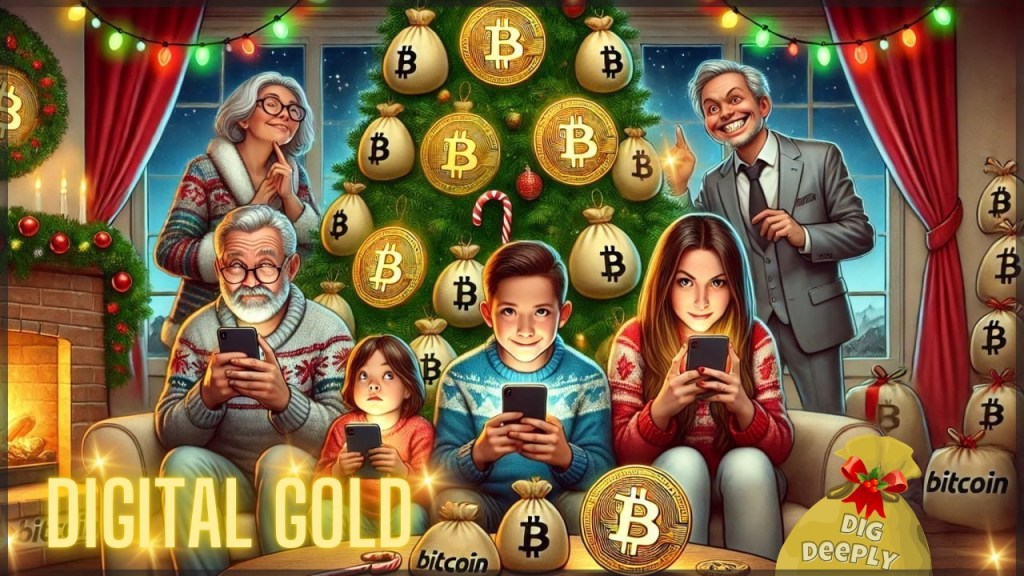
It was December 24th, and the world was electrified. Not because of the approaching Christmas festivities or the snow-covered streets glowing with golden lights. No, the feverish excitement stemmed from a single digital number hovering over the world like a star: Bitcoin had broken the magical one-million-dollar barrier.

People were in a frenzy. On Christmas markets, they no longer bought wooden toys or gingerbread – all that mattered was whether you had enough Satoshi in your digital wallet. Families didn’t exchange gifts but QR codes. Even Santa Claus had adapted: instead of reindeer, a blockchain-sleigh app now powered his digital ride through the cloud.
But deep beneath the North Pole server farm, where the International Christmas Consortium resided, a few seasoned men and women in gray suits were rubbing their hands together. The leader of this conspiratorial circle was none other than Mr. Globcoin, a cunning strategist who had masterfully orchestrated the transition from physical gold to digital glitz. Sitting next to him was Ms. Satoshi, her smile as cold as the code she had allegedly written. The third member, Mr. Fiat, seemed old-fashioned but was renowned for his dexterity in manipulating the global economy.
„People really believe they’re free when they buy Bitcoin”, said Globcoin with a grin. „Meanwhile, we couldn’t control them any better.”
Ms. Satoshi nodded. „Every time someone makes a transaction, we know where they were, what they wanted, and how to get them to do it again.” She tapped a screen displaying blinking Bitcoin addresses. „The blockchain is the perfect data retention system. And the best part? They call it a revolution.”
Mr. Fiat, holding a glass of champagne, raised it ceremoniously. „Who would have thought we’d come this far after the end of the gold standard? Now we have the perfect tool to create the illusion of wealth – without any real value.”
Meanwhile, in a modest living room somewhere in Central Europe, a man named Karl sat with his family. Karl was a simple man who had always stored his money in an old sock. But a month ago, his neighbor Max had convinced him to „invest in the future”. So Karl had put all his savings into Bitcoin. Now, he sat there, smartphone in hand, nervously watching the price fluctuations.
„Dad, why isn’t Santa coming this year?” asked his little daughter Lena.
Karl murmured absentmindedly, „Because Santa also wants to be paid in Bitcoin, sweetheart. And Dad hasn’t earned enough yet.”
At that moment, a push notification appeared on Karl’s screen: „Bitcoin crashes by 30%!” Karl’s heart skipped a beat. He jumped up, his voice trembling. „It’s a crash! It’s all gone!”
Max, who was sipping mulled wine with Karl’s wife, laughed. „Relax, Karl. It’s just a correction. Long-term, it always goes up!”
But Karl wasn’t listening. As he panicked and sold his Bitcoins to salvage a few euros, behind the scenes, Globcoin & Co.’s bots were eagerly buying. The cycle repeated itself: some lost everything, while others grew richer.
Back at the North Pole headquarters, Ms. Satoshi set her coffee cup down. „We should start thinking about the next step. Maybe a world where everyone has to buy their social status as an NFT?”
(Note: NFT stands for Non-Fungible Token, which is just a fancy way of saying you own a unique digital doodad, like a virtual trading card, a JPEG of a banana, or perhaps a pixelated Christmas tree. Perfect for the holidays!)
Globcoin nodded thoughtfully. „Good idea. We’ll call it ‘Tokenized Humanity.’ But not until after New Year’s – we wouldn’t want to ruin their Christmas cheer.”
And so, the world entered another holiday season, blindly dancing in the glow of digital gold, unaware of who was really pulling the strings. The true gift remained hidden under the tree: a simple moment of realization that freedom can never be encoded on a blockchain.

Yes, you read that correctly.
This story was generated by ChatGPT. We asked the AI to write a satirical yet insightful Christmas story on the theme of „Bitcoin as digital gold”. The result was available in less than five seconds.
Generative AI like ChatGPT is often described as a mirror of humanity. But how does it actually work? ChatGPT was trained by analyzing patterns in millions of text passages from the internet. Using complex mathematical algorithms, the AI creates new content that, while based on familiar templates, is uniquely crafted through probabilistic functions.
However, exercise caution when evaluating texts from generative AI. „As the saying goes, you never know what you’re going to get”, explains Lance Eliot, pointing out that AI-generated results are often subject to subjective interpretation.
Whether this Christmas story is true or entirely fictional is up to you to decide. For those still unsure, perhaps our articles „Smart Governance – The Art of Governing” or „CBDC – A Love Story with Reservations” might provide some inspiration.
Season’s Greetings!
Your DigDeeply Team

 Dig Deeply