

„People need to understand finance. At the present moment I think that maybe 1% of the population really understands how the financial system really works.“
Yuval Noah Harari, BIS Innovation Summit, May 2024
Foreword
At the beginning, there was the need. It is the primal instinct that has existed since the dawn of humanity – the desire to secure our survival, enhance our well-being, and find our satisfaction. These fundamental needs for food, shelter, and social connection were the driving force behind our quest for solutions. We started to grow food together, protect ourselves, and establish social networks.
As we began to produce goods and services, we specialized in what we did best. This specialization allowed us to perfect our skills and produce more of what we excelled at. If someone was particularly good at making clothes and another excelled at growing food, trade was the logical consequence. Through exchange, we were able to make the best use of our resources and at the same time expand our variety of products and services.
In the earliest societies, trade began at the local level, where communities exchanged their surpluses to meet their individual needs. Trade not only brought a greater variety of products and services but also economic efficiency. In short, trade is a natural response to our needs and an essential part of human interaction and collaboration. In the past, trade was primarily based on bartering. However, this presented its own challenges.
Then came money. Money made trade simpler and more efficient by representing a fixed value and eliminating the need for direct bartering. It also allowed us to save and plan for the future. The history of money spans from the Neolithic Revolution about 10,000 years ago to the present, with the monetary system continually evolving and adapting to technological advancements.
Initially, shells, grain or livestock were used as a means of payment. Later, coins and paper money appeared. Over time, the banking system and modern currencies as we know them today emerged. With the advent of computers, the internet, smartphones and wireless communication in the 21st century, the digitalization of finance began. This led to the emergence of various electronic payment methods such as credit cards, online bank transfers and cryptocurrencies. Since 2021, there has been increasing discussion about the introduction of CBDC (Central Bank Digital Currency) for the general public.
This article provides an understandable overview of the evolution of monetary systems and key technological developments that will serve as the basis for the future financial system. It sheds light on backgrounds and interesting connections that drive the global efforts to introduce CBDCs as the next milestone in the history of money. We will also take a look at the potential impacts that the introduction of CBDCs could have on our economic, political, social, and cultural life.

1. Monetary systems and their development
1.1. What is money?
1.2. Commodity money
1.3. Representative money
1.4. Fiat money

2. The Fiat system – Alice in Wonderland
2.1. Primary money creation
2.2. Secondary money creation
2.2.1. Secondary money creation via customer deposits
2.2.2. Secondary money creation through lending
2.3. The influence of central bank policy on the money supply
2.4. The risks of loose monetary policy and its effects
2.5. The digitalization trend

3. Cryptocurrencies – All roads lead to Rome
3.1. Distributed Ledger Technology (DLT)
3.2. Blockchain-Technology
3.3. The Token – The Swiss Army Knife
3.4. Centralized vs. Decentralized Ledger System
3.5. Bitcoin (BTC) – Get Rich or Die Tryin’
3.6. Tether (USDT) – Safe Haven (In God We Trust)
3.7. Libra – The King is Dead, Long Live the King!
3.8. Ethereum – Code is Law
3.8.1. Chainlink – Oracles, mediators between the gods and humans
3.8.2. Behind the scenes – Shadows on the wall
3.9. Interim balance

4. CBDC – The Digital EURO – A New Star is Born
4.1. Wholesale CBDC – Nature does not make leaps (or does it)
4.2. Commercial Bank Money Token (CBMT) – Those who do not go with the times, perish with time.
4.3. Retail-CBDC – Heaven Is a Place on Earth

5. A glance into the future – Welcome to the tokenisation continuum

6. Epilogue
1. Monetary systems and their development

1.1. What is money?
Money is essentially a tool that facilitates our ability to obtain things we want or need without having to directly exchange them for other items. Imagine you have an apple that you want to trade for a banana, but your friend doesn’t have a banana; instead, he has something else you don’t necessarily need. This is where money comes into play. You can exchange your apple for money. Then, you can use this money to buy a banana from someone else who has bananas. So, money acts as a „middleman” of sorts in the exchange of goods. It allows us to buy and sell goods and services easily without having to worry about the direct exchange of goods.
The above example works because money serves as a generally accepted medium of exchange. It has an agreed-upon value that people accept and it facilitates the exchange of goods and services, even if they cannot be exchanged directly.
In this example, everyone involved has confidence in the acceptance of money as a means of payment. If you exchange your apple for money, you assume that you can later use this money to buy something else that you want, such as a banana.
Money represents value. However, for money to have value, people must trust that it indeed has value and will continue to hold value in the future, which they can utilize -> Money = Value = Trust.

Every monetary system that has developed throughout history has been a response to the needs and challenges of its time. Let us now take a brief look at how monetary systems have evolved over time.
1.2. Commodity money
As already mentioned, monetary systems arose out of the need to facilitate trade and the exchange of goods and services. Compared to moneyless barter, the use of a certain commodity that could be easily exchanged proved to be more efficient. Examples of such means of exchange were shells, livestock, grain, cocoa beans or precious metals such as gold and silver. These objects had an intrinsic value (actual, fundamental value) or were considered valuable, which made them an acceptable medium of exchange. This oldest form of money is called commodity money.
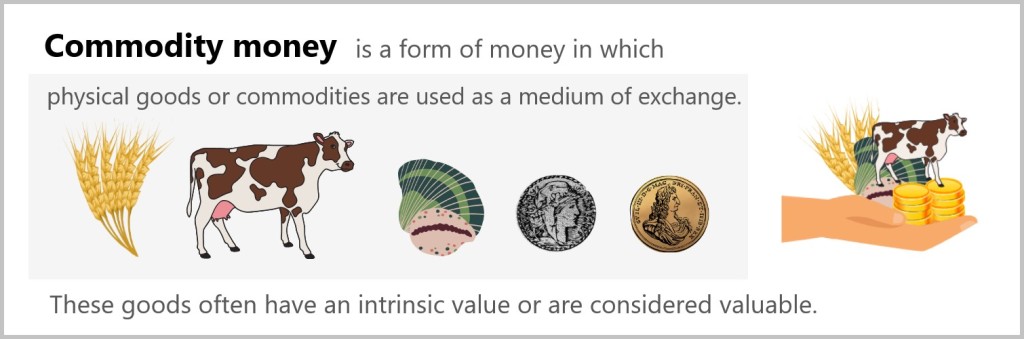
Precious metals turned out to be particularly suitable for use as commodity money, mainly due to their high durability. However, these metals had to be laboriously weighed and divided as required. Therefore, the next logical development step was the production of coins or bars that had a fixed precious metal content and a specific nominal value.
1.3. Representative money
Over the course of history, people found it cumbersome to transport gold bars or other forms of commodity money over long distances. For this reason, paper money eventually emerged from these mediums of exchange, serving as the basis for representative money. Representative money is backed by a physical object or commodity. A simple example of representative money is a gold certificate.
Suppose you own a gold certificate that states it entitles you to a certain amount of gold, for example, one ounce of gold. The certificate itself is not physical gold but a promise that the holder of this certificate will receive a specified amount of gold from a designated place, such as a bank or a gold repository.
Now you can use this gold certificate to buy goods or services. For example, if you want to buy a bicycle, you can give the seller the gold certificate. The seller accepts the certificate because he trusts that he can later redeem it at the bank or gold repository for an actual ounce of gold.
In this way, the gold certificate represents the value of the gold. It facilitates trading without physical gold actually having to change hands.
Banknotes and coins can also take on the role of the gold certificate in the above example. Suppose, instead of a gold certificate, you have banknotes issued by the bank that represent the value of a certain amount of gold (e.g. 1,000 US dollars for a gold bar). These banknotes can then be used as a means of payment to buy goods or services. The seller accepts the banknotes because they trust that they can redeem them at the bank for the equivalent value in gold if needed.
The money itself has no intrinsic value but represents the value of the underlying asset and is used as a medium of exchange.
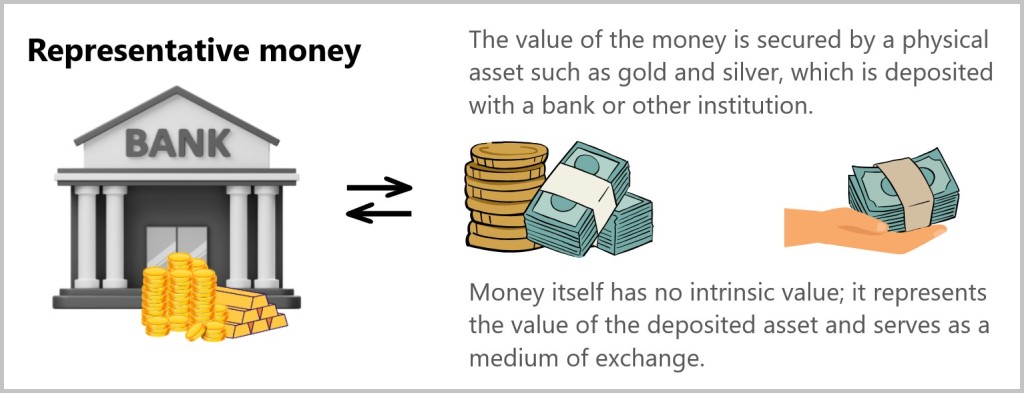
Banknotes proved to be not only much more convenient but also allowed people to, for example, spend a dollar bill for a cup of coffee without having to cut their gold bar into a thousand pieces. If they wanted their money back, they simply brought the dollar bills back to the bank to redeem them for the actual form of money, in this case, the gold bar, whenever they needed it. In this way, paper began to be used as a practical and convenient means of payment.
1.4. Fiat money
However, in the 20th century, a combination of economic and political factors led to the severance of this link between paper money and the gold it represents.
During the two World Wars, many countries had to use a large portion of their gold reserves to cover the costs of the war. To inject more money into circulation, some countries temporarily abandoned the gold standard. This led to increased inflation and currency instability.
During economic crises like the Great Depression or economic downturns, countries couldn’t effectively and flexibly respond due to the rigid monetary constraints of the gold standard. This led to prolonged recessions and increased unemployment.
After the Second World War, the global economy again experienced strong growth and an increase in international trade. However, the strict limitations of the gold standard proved to be detrimental to the flexibility of monetary policy to respond to such economic changes.
From a political point of view, the gold standard was seen as a restriction that limited governments‘ freedom of action and prevented them from pursuing a proactive economic policy.
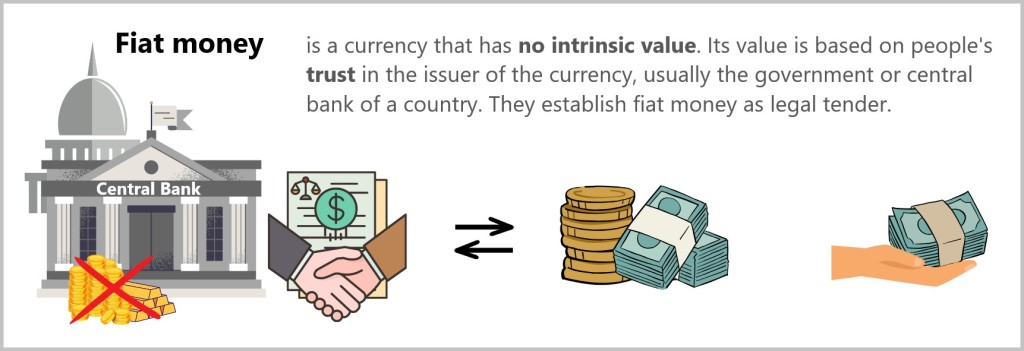
It suffices to say that governments assured their citizens that they themselves would guarantee the value of this paper money. Society agreed to trade with paper money based solely on the promise of governments. Thus, the so-called fiat currency emerged.
Fiat money is money that derives its value not from a physical asset such as gold or silver, but from the trust and acceptance of the people and the authority of the government that issues it. A simple example of fiat money is the paper money or coins we use every day. The value of these bills and coins is supported by the trust that they are accepted as a means of payment and guaranteed by the government that issues them. As long as people have confidence in the stability and value of fiat money, it retains its value and function as a medium of exchange.
A compact yet comprehensive explanation and overview of this topic is provided by the video contribution „What is money? The value of money explained simply” by Finance Fellows.
2. The Fiat system – Alice in Wonderland

„It is well enough that people of the nation do not understand our banking and monetary system, for if they did, I believe there would be a revolution before tomorrow morning.”
Henry Ford
Over time, the trust model has changed – from the trustworthiness of a material object such as gold to trust in institutions such as central banks.
In the fiat system, governments determine the value of a currency and declare it as legal tender. It is the government’s responsibility to decide whether a medium of exchange is recognized for financial transactions, commercial settlements, or general trade within a country or jurisdiction.
The fiat banking system includes a range of banks, including central banks and commercial banks, as shown in the following figure.
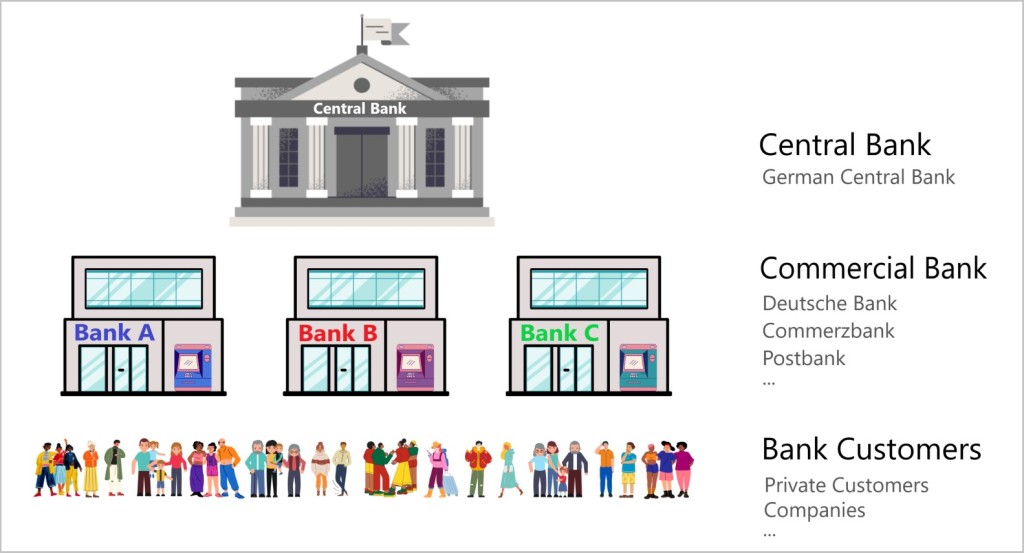
The central bank is the highest banking authority in a country and is responsible for managing monetary policy and regulating the money supply in circulation. It is the only institution authorized to issue legal tender. The central bank influences the flow of money by setting interest rates, printing money or withdrawing it from circulation, and implementing other monetary policies to promote the stability of the currency and the economy. This also includes monitoring the banking system. Central banks are usually established and supervised as independent institutions by a country’s government. They often collaborate with other government agencies and international institutions to support economic stability.
Commercial banks are private banks that provide financial services to individuals, businesses and other organizations. They accept deposits, grant loans, facilitate transactions and offer other banking services. These banks use the currency units issued by the central bank to conduct business and settle transactions.
Each commercial bank is required to maintain an account with the central bank, known as a central bank account. In this account, the commercial bank has a credit balance that it can use to receive cash from the central bank or to transfer cash to it. This credit balance, along with the physical cash issued by the central bank, is collectively referred to as central bank money, as it is exclusively created by the central bank.

The central bank balances of commercial banks can arise in various ways. On the one hand, the central bank grants these banks loans, which are then recorded as credit balances on the commercial bank’s account. In order to receive these loans, the commercial banks must deposit collateral such as securities and pay interest on them.
Securities are papers that represent a certain value. They can include, for example, stocks, bonds, or investment fund shares.
Stocks are shares in a company. When you buy a stock, you own a small part of that company.
Bonds are debt securities. When you buy a bond, you are lending money to the issuer (such as a government or a company) and, in return, receive interest payments and the borrowed money back at a later date.
Investment fund shares are part of a fund that is managed by a fund manager. This fund invests the money of many investors in a variety of securities in order to spread the risk.
On the other hand, central bank balances can also arise when the central bank acquires assets such as real estate, government bonds, or gold from commercial banks. In this case, the central bank credits the purchase amount to the account of the respective commercial bank.
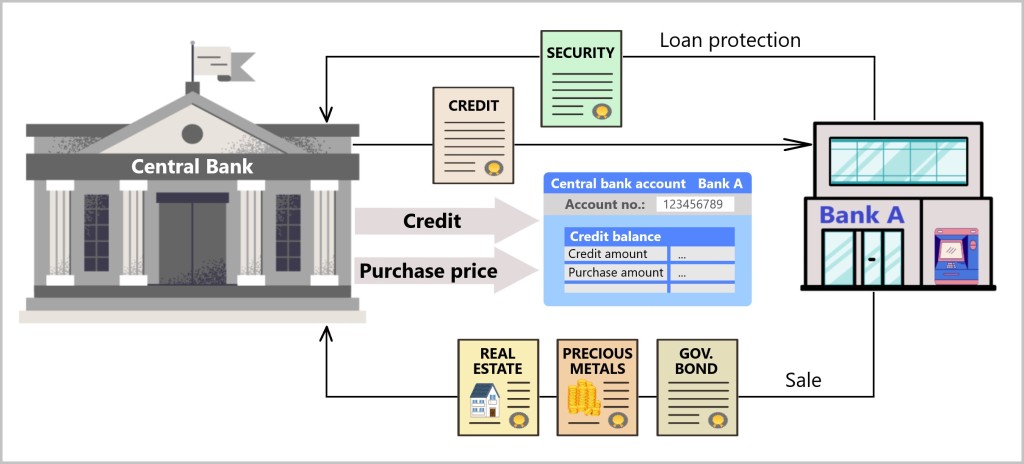
Additionally, commercial banks are required to maintain a minimum balance on their central bank accounts, known as the minimum reserve. This minimum reserve is determined by the central bank. It calculates this by summing the deposits across all commercial bank accounts and multiplying this total by a specified percentage.

The function of a central bank balance is to enable commercial banks to provide cash to their customers when needed. For example, when customers want to withdraw money, commercial banks must ensure they have enough cash reserves to meet this demand. This requires commercial banks to access and utilize their balances with the central bank to procure cash.
Furthermore, the central bank balances of commercial banks are needed for non-cash payments between banks. When one commercial bank wants to transfer money to another commercial bank, this transaction is typically settled through their balances with the central bank.
Fiat Lux – Money out of Nothing
In reference to the biblical phrase „Fiat Lux”, the term „Fiat money” refers to money being created „out of nothing” in a sense. The following explanations illustrate this process.
2.1. Primary money creation
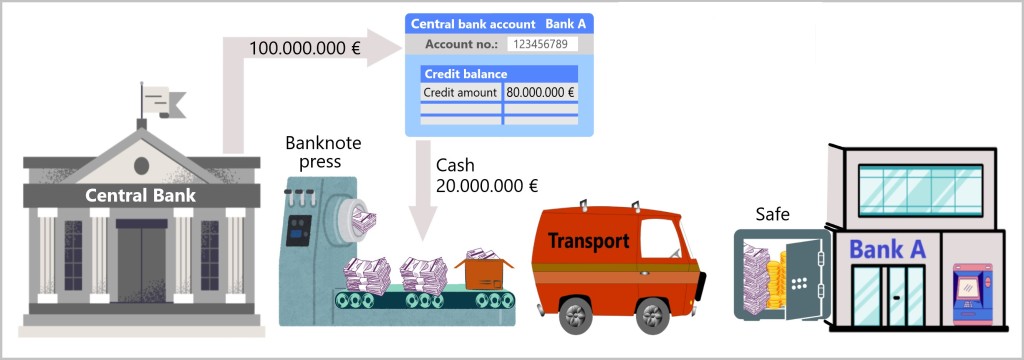
The process begins with a government mandate. Suppose the government decides to inject an additional 100 million euros into circulation to stimulate the economy. The central bank is responsible for implementing this mandate, for example, by providing this amount to commercial banks as credit. This increases the credit balance on the commercial banks‘ central bank accounts. They can then withdraw a portion or the entire sum in cash from their central bank accounts. To provide the additional cash, the corresponding banknotes are subsequently printed and transported to the vaults of the commercial banks using cash transporters.
The 100 million euros are literally created out of nothing, as they are not backed by an intrinsic value such as gold or silver. But that’s just the first part of the money creation chain.
2.2. Secondary money creation
As already mentioned, commercial banks act as intermediaries between the central bank and the general public within the fiat financial system. They accept deposits from individuals and companies and hold a portion of these deposits in reserve. The banks use the rest to grant loans and earn interest income. In this way, the banking system plays an important role in the creation and distribution of money in the economic cycle.
2.2.1. Secondary money creation via customer deposits
Suppose Alice has received EUR 100 in cash from her grandmother for her birthday. As she doesn’t want to carry the cash with her all the time, she decides to deposit it in her bank account at Bank A. This converts the cash into book money, also known as scriptural money.
The bank books Alice’s deposit on the liabilities side of its balance sheet. For the bank, this deposit represents a liability, as it owes Alice EUR 100 in cash. To balance the balance sheet, the bank posts the EUR 100 to its reserves. As a result, the EUR 100 are physically deposited in the bank’s vault and increase the bank’s assets.
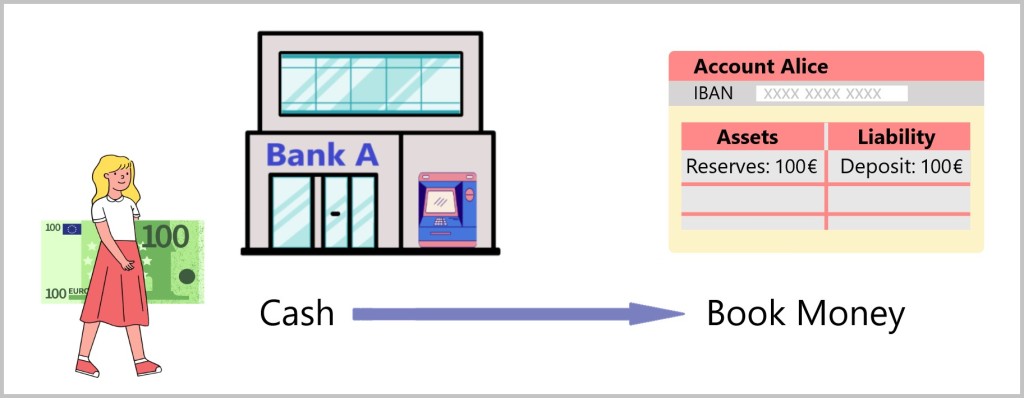
In most jurisdictions, a bank deposit is not considered a security deposit. This means that the money deposited no longer remains in the customer’s possession. Instead, the money becomes the property of the bank and the customer receives in exchange an asset known as a deposit account (current or savings account). This deposit account is shown as a liability on the bank’s balance sheet. In simple terms, this means that a customer effectively gives their money to the bank, which keeps it in its possession. In return, the customer receives a promise from the bank to get their money back at a later date or as required. This promise is usually documented by the customer’s deposit account, which is a liability of the bank.
As the money now effectively belongs to the bank, it uses it to make a profit by lending it out further. This is where the concept of fractional reserves comes into play. Minimum reserves are an essential part of banking and are applied worldwide. It states that banks that accept deposits from the public must only hold a portion of these deposits as a reserve in liquid assets. These bank reserves can be held either as cash in the commercial bank’s vaults or as balances in the commercial bank’s account with the central bank. As described above, the central bank of a country has the power to determine a fixed amount of reserves that banks must hold. This amount is referred to as the „reserve requirement” or „reserve ratio”. [Fractional-reserve banking]
In our example, we assume that the minimum reserve ratio is 10%. This means that Alice’s bank can grant an amount of EUR 90 as a loan. If the borrower buys a bicycle with this EUR 90 and transfers the money to the bicycle seller’s account at Bank B, Bank B has a liability to the bicycle seller in the amount of EUR 90. In order to balance its balance sheet, Bank B transfers this EUR 90 as a reserve, which it books as part of its assets.
The original EUR 100 in cash has now become EUR 190 in book money. After the next cycle, this will become EUR 271.
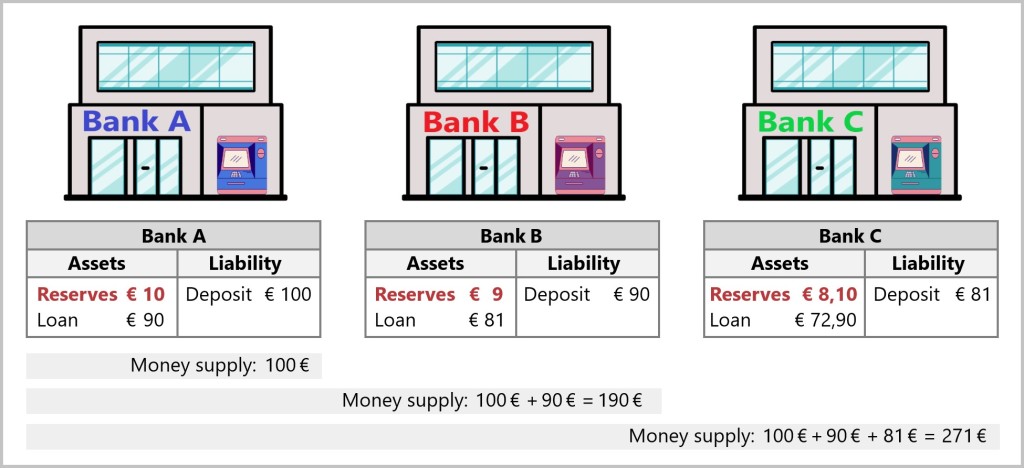
After each new round of lending, the amount of book money increases. With a minimum reserve ratio of 10%, up to EUR 1,000 of book money can be created from EUR 100 of central bank money (in the form of cash).
The maximum amount of book money that can be created out of nothing depends on the minimum reserve ratio. The money creation multiplier is calculated as follows:

This example demonstrates the secondary creation of money from customer deposits at commercial banks. How this process takes place in the case of lending can be illustrated as follows.
2.2.2. Secondary money creation through lending
Suppose Alice’s family wants to buy a house and applies for a loan of EUR 100,000 from their commercial bank. The bank approves the loan and posts the amount of EUR 100,000 to the family’s bank account. In this scenario, the bank does not use the money from its customers‘ deposits, but borrows it from the central bank.
With a minimum reserve ratio of 10%, the commercial bank only needs EUR 10,000 in central bank money to grant a loan of EUR 100,000 in the form of book money. This creates an additional EUR 90,000 in book money out of nothing. The bank books the loan amount on the assets side of its balance sheet, which means that the bank recognizes the claim to repayment of the loan as an asset on its balance sheet. The bank can therefore use part of the approved loan as a basis for granting new loans. This creates new book money, as the bank grants loans that exceed the original deposit. This process is known as the multiplier of lending and contributes to the expansion of the money supply in the economy.
The family can now pay tradesmen and construction companies, who in turn buy building materials and pay wages to their employees. The book money is then transferred to other commercial banks, which can lend it again according to the principle described in chapter 2.2.1.
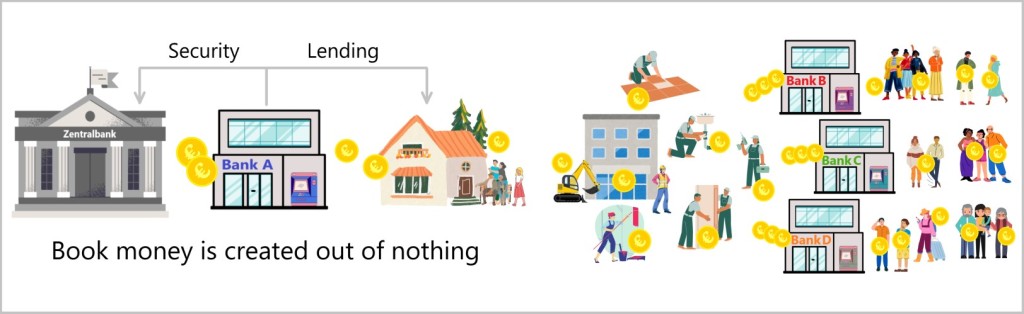
All in all, this means that considerably more money can be lent than was originally put into circulation.
2.3. The influence of central bank policy on the money supply
By defining the minimum reserve ratio, the central bank can indirectly influence the book money supply.
In addition to the minimum reserve rate, the central bank can influence monetary policy through the so-called key interest rate. The key interest rate is the interest rate at which commercial banks can borrow money from the central bank. If the central bank lowers the key interest rate, the supply of credit is increased and the economy is stimulated, as it becomes cheaper for commercial banks to borrow money and pass it on to companies and consumers. When the central bank raises the prime rate, this usually dampens inflation by making it more expensive to borrow money, which reduces consumer spending and business investment. The prime rate therefore has a significant impact on borrowing costs, the availability of credit and therefore the overall economic environment. That’s the theory, at least.
A minimum reserve of 10% was assumed in our calculation examples. The European Central Bank (ECB) stipulates a minimum reserve of just 1%.
Conclusion: Fiat money is created through a combination of government authority, central bank action, commercial bank lending and fractional reserve banking. It is based on trust in the government and the financial system, not on an intrinsic value of the currency.
2.4. The risks of loose monetary policy and its effects
Some consider this dynamic as a collective illusion. But what is this claim based on?
Central banks, by controlling the money supply and influencing interest rates, can lead to over-lending and excessive debt through loose monetary policy. The fiat money system allows banks to lend substantial amounts without adequate collateral or risk assessment, leading to an increase in risky loans.
This practice enables the creation of complex financial products that can spread and obscure risks, increasing the vulnerability of the financial system to shocks. Additionally, government bailout actions incentivize risky behavior, as banks and financial institutions may assume they will be supported in case of trouble, leading to excessive risk-taking and engagement in risky transactions.
A balanced money supply in circulation is considered a crucial driver of economic growth. However, a rapid increase in the money supply without corresponding real economic growth can lead to overvaluation of assets such as stocks, real estate, or commodities. This poses the risk of asset bubbles, the instability of which can manifest in the long term and lead to sudden price corrections or economic turbulence.
Such a scenario emerged in the first few years of this century. For a long period of time, commercial banks speculated that residential real estate prices in the USA would rise inexorably. A loose monetary policy with low interest rates and generous lending made it possible for even people without a regular income to obtain real estate loans. The banks regarded the residential properties they financed as the sole collateral for the loans, which boosted demand for real estate and drove prices up irrationally.
An economic downturn, accompanied by interest rate hikes by the US Federal Reserve, meant that more and more borrowers were no longer able to service their rising home loan installments. This forced a growing number of people to sell their properties, which in turn led to a collapse in property prices. However, as these properties served as collateral for the loans granted, the house of cards collapsed and the commercial banks suffered massive financial losses.
Trust between the banks was shaken, causing them to stop lending money to each other. As a result, the renowned investment bank Lehman Brothers was unable to refinance itself, became illiquid and went bankrupt. This chain reaction not only spread to the banking system, but also had an impact on the real economy. Companies suddenly found it difficult to obtain credit and the consequences were inevitable.
Due to the global interconnection and digitalization of the financial system, the shockwaves of this crisis quickly spread around the world. The crisis in one area of the financial system could quickly spill over into other areas, thus increasing the danger of system-wide risks.
Conclusion: The structure of the fiat money system facilitated the global financial crisis of 2007-2008, which led to a loss of confidence in the financial system and serious economic consequences worldwide.
To counteract this severe crisis, both the European Central Bank (ECB) and the US Federal Reserve (FED) intervened massively, lowering the key interest rate to zero percent over extended periods. Their goal was to facilitate commercial banks‘ access to central bank money, circulate it in the form of book money, and stimulate the economy by granting new loans.
As a result of this policy, the money supply M3 in the Eurozone has continuously grown over the past 20 years – from 4.67 trillion EUR in 1999 to over 16 trillion EUR in 2023.
The money supply M3 is a measure of the total money available in an economy that is readily accessible. It includes not only cash and coins but also money in bank accounts, savings deposits, short-term investments like money market funds, and similar liquid assets. This broader definition allows for capturing the overall liquidity of an economy, meaning how much money is available in total for purchasing goods or making investments.
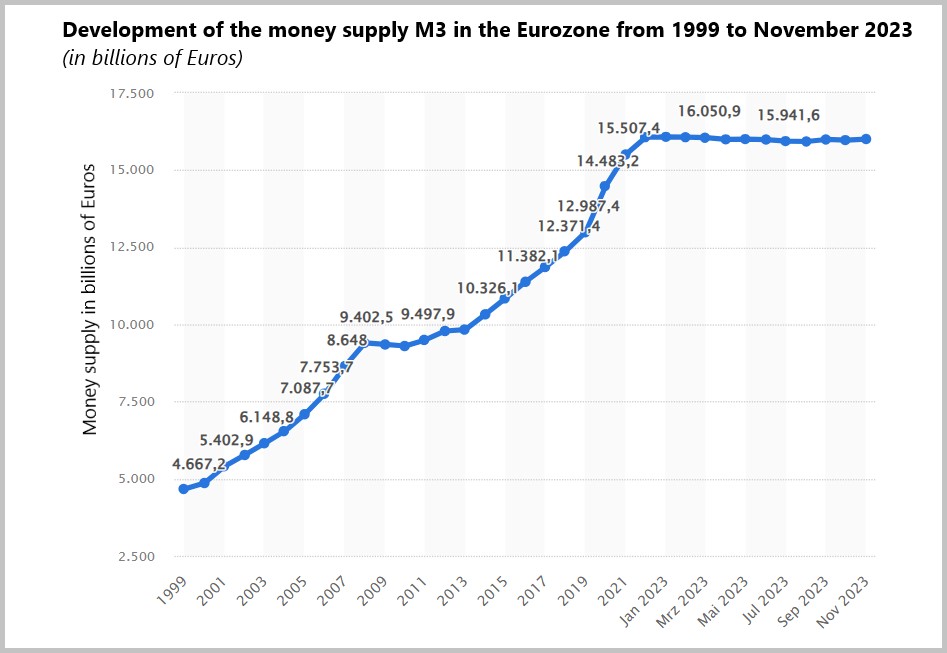
However, the velocity of money circulation in the Eurozone has decreased over the past 20 years, which can be attributed to various factors. These include the impacts of the 2007-2008 financial crisis, changed credit conditions, the monetary policies of the European Central Bank (ECB), as well as structural changes in the economy.
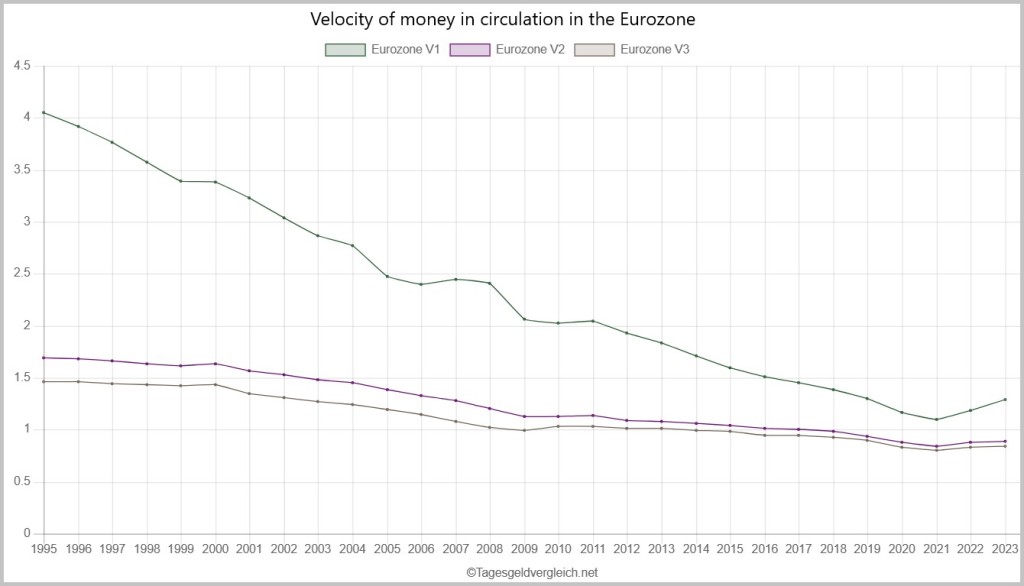
In macroeconomic terms, the velocity of money is an important indicator of the activity and pace of economic activity in a country or economic region. It shows how quickly money circulates through the economic system and how efficiently it is used for the purchase of goods and services.
A high velocity of money in circulation often indicates a vibrant economy where many transactions take place and money is passed quickly from one hand to the next. This can be a sign of a high level of economic activity and growth. A faster velocity also means that the same money is used more often, which increases the multiplier effect and helps to increase gross domestic product (GDP).
On the other hand, a low velocity of money can indicate economic problems. If money circulates slowly and transactions decrease, this can be a sign of economic stagnation or lower demand for goods and services. This can lead to deflationary tendencies and affect economic activity.
A decreasing velocity of money alongside an increasing money supply can pose a challenge for central banks, as this could indicate that monetary policy measures are becoming less effective. In such a situation, central banks may consider additional measures to increase the velocity of money and stimulate economic activity.
A decline in the velocity of money could indicate a loss of confidence in the financial system or the general economic situation, leading people to hoard their money or reduce consumption.
Conclusion: The effectiveness of central banks‘ monetary policy measures is reaching its limits and points to structural problems in the existing financial system.
2.5. The digitalization trend
The evolution of money goes hand in hand with the progress of technology. The rapid advancements in areas such as computer technology, the internet, smartphones, wireless communication, and artificial intelligence have made this relationship increasingly complex. These technological advances have contributed to the predominance of digital forms of money in modern societies, supported by complex financial systems and digital transactions. Physical cash is increasingly being replaced by digital alternatives such as debit and credit cards, electronic wallets or apps, as well as digital deposits at commercial banks.
Since 2020, many of us have become aware that we are living in a time of change, bringing comprehensive transformations that affect society as a whole. The ongoing digitalization across industrial, public, and private sectors has further increased the acceptance of digital currencies. Digitalization also amplifies the concentration of power and data in the hands of a few large financial institutions or technology companies. This raises risks associated with monopolistic practices and data privacy.
In parallel, the use of algorithmic trading strategies and high-frequency trading in financial markets could lead to unpredictable price fluctuations and more volatile markets, increasing the risk of financial crises. Digitalization has heightened the complexity and opacity of the financial system, especially in the realm of derivatives and structured financial products. This complexity could make it more challenging to detect and manage financial crises.
Derivatives are contracts that derive their value from the price of other things. There are various types of derivatives, but two of the most common are options and futures. Imagine you go to the market and buy an apple. You know the price for an apple is 1 euro. Now, imagine you could enter into a contract that gives you the right to buy that apple at the same price in a week, regardless of how the price may change in the meantime. That’s an option. A future would be placing an order for an apple at a fixed price, but the delivery is scheduled for a week later. In both cases, people are seeking to hedge against or profit from price changes without immediately buying the apple.
Now, imagine you’re in a candy store and you want to buy a variety of candies, but you don’t want just one type. So, you ask the store owner to put together a bag with a mix of different candies. Structured financial products are similar. Banks and financial institutions bundle various types of investments like loans, mortgages, or debts and then sell them as a package to investors. These packages have different parts with varying risks and returns. Some parts are safer, while others are riskier. The idea is that investors can choose which parts to invest in, depending on how much risk they want to take. These packages can be very complicated, and sometimes even experts don’t fully understand what’s inside. This can lead to problems if things don’t go as planned.
Conclusion: The trend towards digitalization exacerbates the structural weaknesses of the fiat financial system and poses new complex challenges for regulatory authorities to ensure the long-term stability of the financial system under these conditions. This raises the question of how the existing fiat financial system should be further reformed.
Technological development has led to the parallel emergence of a new type of currency, the cryptocurrency. Cryptocurrencies are digital or virtual currencies that are based on cryptographic techniques and serve as a means of exchanging value. Unlike traditional currencies, cryptocurrencies are not controlled by governments or central banks. Instead, they are managed via a decentralized computer network. They use strong encryption techniques and complex algorithm-based processes to secure transactions, ensure independence from central authorities and regulate the creation of new units. Well-known examples of cryptocurrencies are Bitcoin, Ether and Tether.
Supporters of cryptocurrencies view Bitcoin as a trailblazer for the separation of state and monetary systems, considering this development as one of the most significant revolutions of all time. In fact, since its inception in 2009, Bitcoin has paved the way for the development of numerous other cryptocurrencies and blockchain projects.
Conclusion: These novel structures upon which cryptocurrencies are based represent another serious challenge to the traditional fiat money system.
Given these challenges, the statements made by Christine Lagarde, President of the ECB (European Central Bank), and Fabio Panetta, Member of the ECB Executive Board and Chair of the High-Level Task Force for a Digital Euro, appear rather „mild”.
„We need to prepare our currency for the future. We envisage a digital euro as a digital form of cash that can be used for all digital payments, free of charge, and that meets the highest privacy standards. It would coexist alongside physical cash, which will always be available, leaving no one behind.” [Christine Lagarde]
„As people increasingly choose to pay digitally, we should be ready to issue a digital euro alongside cash. A digital euro would increase the efficiency of European payments and contribute to Europe’s strategic autonomy.” [Fabio Panetta]
At present, non-banks such as private individuals and companies only have access to central bank money via cash. All cashless transactions are processed exclusively via the book money of commercial banks. With the introduction of the digital euro, however, cashless transactions for the general public will also be possible directly with central bank money. As a result, central bank money will be integrated into the entire economic cycle in addition to the commercial banks‘ book money. This suggests that the introduction of the digital euro as a means of payment for non-banks will be accompanied by a profound structural change to the current fiat money system.
From this perspective, the controversial discussions about the introduction and design of the digital euro as a CBDC (Central Bank Digital Currency) are also understandable given its societal relevance.
From the perspective of the average citizen, the question arises: Will central bank digital currencies make our lives easier and safer, or is it a risky experiment?
Before delving deeper into the discussion, it’s important to note that both CBDCs and cryptocurrencies are part of the digital currency revolution. Some key technological elements used in cryptocurrencies can also be employed in CBDCs. These fundamental elements directly impact the characteristics and practical application of CBDCs.
To get a better understanding of CBDC, we will take a closer look at some key elements of the most popular cryptocurrencies in the next chapter.
3. Cryptocurrencies – All roads lead to Rome

„Banks must be trusted to hold our money and transfer it electronically, but they lend it out in waves of credit bubbles with barely a fraction in reserve. We have to trust them with our privacy, trust them not to let identity thieves drain our accounts. Their massive overhead costs make micropayments impossible.“
Satoshi Nakamoto, Post im P2P-Foundation-Forum
The financial crisis of 2007-2008 played a decisive role in the emergence of cryptocurrencies such as Bitcoin. It led to a loss of confidence in traditional financial institutions and the existing fiat money system. Many people were disappointed by the response of banks and governments to the crisis and looked for alternative ways to store their money and conduct transactions that were free from government control and interference.
Bitcoin was created shortly after the outbreak of the financial crisis in 2008 by an anonymous person or group with the pseudonym Satoshi Nakamoto. Bitcoin’s whitepaper, published in the same year, presented an idea for a decentralized digital currency that works without a central authority or intermediaries. This concept came at just the right time, when confidence in the traditional financial system was shaken. The financial crisis of 2007-2008 therefore served as a catalyst for the emergence of cryptocurrencies, as it raised awareness of the weaknesses of the existing financial system and highlighted the need for alternative ways to store and transact value.
Cryptocurrencies have the potential to influence and transform the traditional monetary system. To understand why this is the case, we will first explain some basic terms in this context without digressing into technical details.
3.1. Distributed Ledger Technology (DLT)
A ledger is a term from the world of accounting and finance that generally refers to a record of financial transactions in the form of a book or database. It is used to record the current status of assets, liabilities and capital of a company or organization. A ledger can be kept either manually or electronically and typically contains entries on income, expenses, transfers and other financial transactions.
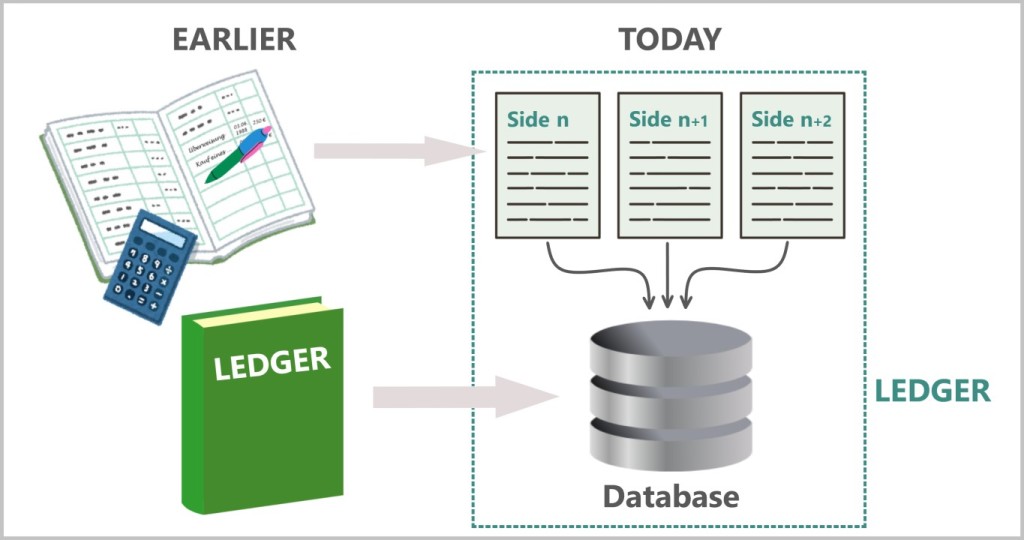
A traditional ledger is usually centralized, which means that a central authority has control over the data and also centrally controls access to it. This centralization makes traditional ledgers more susceptible to fraud or data manipulation, as they are controlled by a single entity.
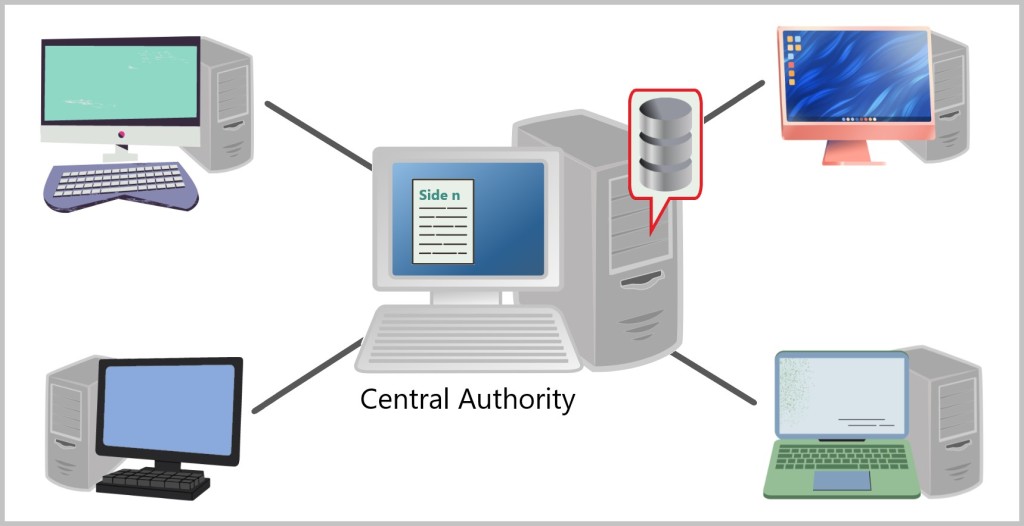
A distributed ledger is a decentralized database that stores and synchronizes transaction data across multiple locations. Unlike centralized ledgers, which are managed by a single central location, the data in a distributed ledger resides on many distributed nodes or computers that are connected via a network. This decentralized nature ensures greater security as the data is stored on multiple nodes and changes are cryptographically secured.

In summary, the main difference between a traditional ledger and a distributed ledger lies in their centralized or decentralized structure, which has implications for the control, security and efficiency of data tracking.
A centralized ledger requires an authority (bank, cloud, etc.), while distributed ledger technology enables P2P-exchange via computers. (Peer-to-peer (P2P) is a concept that describes a direct interaction or communication between participants in a network without the need for a central intermediary). [iMi Blockchain]
3.2. Blockchain-Technology
Distributed ledger technology (DLT) and blockchain technology are closely related, as blockchain is a specific implementation of DLT. DLT can be implemented in various ways in practice, with blockchain technology being the best known and most widespread form. DLT and blockchain technology are often equated, but blockchain is merely a specific variant of DLT.
You can think of the blockchain as a long, public notebook (ledger). Each page of this notebook represents a block. Within this notebook, all transactions ever made are recorded.
Each block contains a list of transactions, such as someone sending money to someone else. Once a page of the notebook is full, a new page is added, and this is linked to the previous page. This linking is like a chain that holds all the pages together – hence the name „blockchain”.

In order to understand the basic operating principle of blockchain technology, it is important to understand how a system is set up that allows all participants to create, verify and update data.
Peer-to-Peer (P2P) Network
A peer-to-peer (P2P) network is required to operate a blockchain. This is a network of computers known as nodes, all of which have equal rights. Anyone can join this network (see Figure 17). The P2P network enables the nodes to communicate with each other, exchange information and perform tasks without the need for a central server. These P2P networks can be set up via the global Internet infrastructure, where computers are directly connected to each other.
Cryptography
As anyone can join the network, including potentially harmful actors, it is crucial that communication between nodes is secure and unaltered. Cryptography plays a central role here. It enables secure communication in an environment where potential threats exist. Encryption converts information in such a way that it can only be read by participants who have the corresponding „keys” for decryption. In this way, messages can be transmitted securely without unauthorized persons being able to intercept or alter them. This also makes it possible to prove the authenticity of your own messages, even if there are potentially malicious actors in the network.
In Figure 18, the entry in the „Hash” field represents a cryptographic checksum or fingerprint of the data in the block, while the entry in the „Prev” field (previous hash) is the hash value of the previous block in the blockchain. The use of cryptographic hash functions ensures that the integrity of the blockchain is maintained and that changes to past blocks can be easily detected.
Consensus algorithm
The third element is the consensus algorithm. This is like a rule or procedure that ensures that all participants in a system agree on which data is valid and how it can be changed. In a decentralized network like the blockchain, many different nodes or computers communicate with each other. The consensus algorithm helps these computers to agree on a common view, even if they might have different information. This allows them to ensure that the data they receive is correct and that everyone in the network agrees on what to do with this data.
There are various consensus algorithms used in blockchain networks to ensure that all participants agree on which transactions are valid and which are not. Each of these consensus algorithms has its own advantages and disadvantages and is selected according to the requirements and objectives of the blockchain network. The Proof-of-Work (POW) algorithm gained particular fame with the first cryptocurrency Bitcoin.
Proof-of-Work (PoW) Algorithm
What happens with the PoW algorithm? Newly added transactions are recorded in a new block. Before this block can be added to the blockchain, its content must be validated and confirmed. As soon as the block is full, the PoW algorithm is activated.
In this algorithm, a computer in the network must successfully solve a puzzle (complex mathematical task) in order to validate the content of the new block. The solution to this task is called a Proof-of-Work. As soon as a computer in the network has successfully solved the puzzle and proposed a new block for connection to the blockchain, this block is checked and validated by the other computers in the network. Each computer in the network applies the rules of the Bitcoin protocol to ensure that the transactions are valid and that the new block complies with the consensus rules. These rules include checking factors such as the validity of signatures, the correctness of the transaction data and the accuracy of the Proof-of-Work.
If the other computers in the network determine that the new block is valid, it is added to the blockchain and the transactions in it are confirmed. If the block does not meet the consensus rules or the transactions are invalid, the block is rejected by the other computers in the network and the process starts again to find another valid block.
In the Proof-of-Work (PoW) algorithm, as used in Bitcoin, several computers in the network compete with each other to solve this complex mathematical task. Solving the task requires a lot of computing power and energy.
In Figure 18, the entry in the „Nonce” field (an abbreviation for „Number used once”) represents a random number that is processed together with other data in a block to generate a hash that must meet certain criteria to be accepted as a valid block. This value is directly linked to the PoW algorithm.
Reward and punishment
For the proper operation of a decentralized blockchain, another concept from game theory comes to the forefront: „reward and punishment”. In game theory, the term „reward and punishment” refers to the incentives given to players to encourage or discourage certain behaviors. Rewards can be positive incentives that players receive when they perform certain actions or achieve certain goals. Punishments are negative incentives that players suffer when they perform undesirable actions or violate certain rules. These rewards and punishments are used to influence player behavior and encourage the achievement of in-game goals.
This rewards participants who help maintain the records in the blockchain and add new blocks to the blockchain. In the case of Bitcoin, this reward means that a token, or virtual coin, is awarded every time a consensus is reached and a new block is added to the chain. On the other hand, malicious actors who try to circumvent or manipulate the system lose the computing power spent during the Proof-of-Work process, or risk losing their coins.
In conclusion, it is important to recognize that the punishment and reward system has an impact on psychological behavior. It changes the rules of the system from something you have to follow to something you want to follow because it is in your own interest to do so.
Critical P2P-network size
In reality, a blockchain is considered decentralized if it has enough independent validators or nodes that validate the transactions. These nodes are spread across different geographical locations and no single party has control over the network.
A summary of the key features of blockchain technology can be found in this video.
A more detailed visual demonstration of the functionality of a blockchain using the example of financial transactions can be found here and here.
The key strategic benefit of using blockchain technology to solve problems lies in its decentralization. The selection of blockchain technology as a solution method is only justified if the underlying problem is actually due to centralization. If decentralization is not required or desired, it is likely that a centralized solution is more suitable and blockchain technology is not necessary.
The central question is: Is our world currently ready for the comprehensive implementation of complex blockchain technology that entails decentralization?
3.3. The Token – The Swiss Army Knife
When explaining the reward mechanism as an essential component of a blockchain in the previous chapter, the term „token” was used. It makes sense to explain this term in simple language here.
A token can appear in various forms.
Generally speaking in the IT sector, a token is a type of digital key or identifier. It is used to confirm the identity of a user or entity and gain access to a system or resource. Think of it like an ID card that you show to get into a building. For example, a token can be a password, a biometric feature (like a fingerprint) or a special code that you enter or present to authenticate yourself. It is used to ensure security and access control in IT systems.
In the blockchain world, a token is a digital unit with multiple functions. It can serve as a cryptocurrency, be digital representations of fiat currencies on blockchain platforms and be used for transactions. Tokens can also be digital representations of real objects such as real estate or works of art.
A token can represent not only a digital object, but also its properties. This depends on the type of token and its implementation on the blockchain. Consider, for example, a tokenized work of art. Such a token could not only represent the artwork itself, but also contain information about the artist, year of publication, size, ownership history and even license rights.
In addition, a token can represent certain functions within a blockchain network, such as usage rights, access rights, voting rights, entitlement rights, etc. Depending on the type and intended use, tokens can have different characteristics and functionalities.
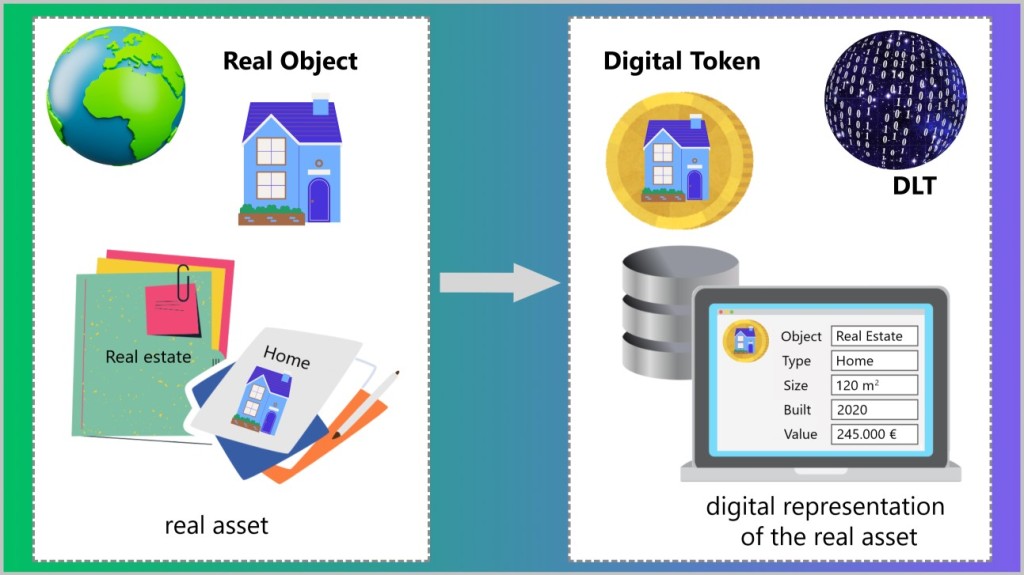
Tokens can be seen as a kind of toolkit, allowing digital objects, their properties, and various functions to be combined. These are then used as an element in a predefined algorithm on a digital platform such as a blockchain. This algorithm determines how the tokens can be created, transferred, traded, and used. This logic dictates how the tokens operate and what rules they must adhere to.
A token could metaphorically be seen as a universal tool that can be used in a variety of situations. Much like a Swiss army knife is versatile and offers different functions, a token in a blockchain network can be used for various purposes, from holding value to executing pre-programmed processes.
Further information on the topic of tokens and their role in the future financial system is provided in the following chapters.
3.4. Centralized vs. Decentralized Ledger System
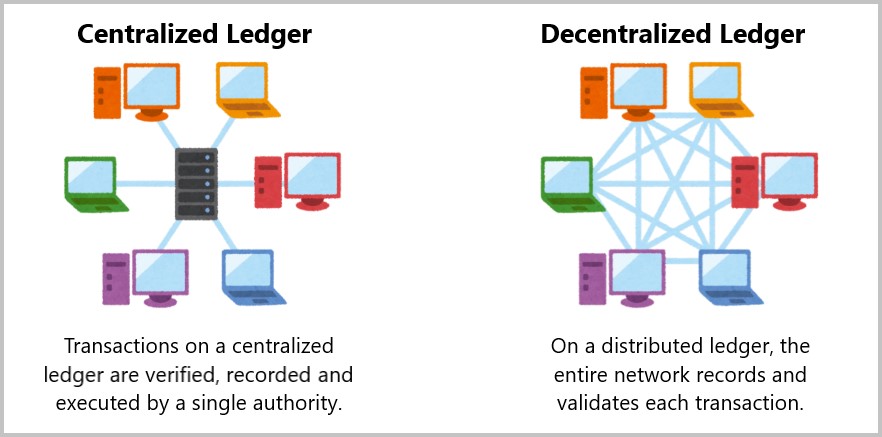
Centralized Ledger System
The existing financial system is based on centralized ledger systems in which transactions and account balances are managed and monitored by a central authority or institution. Banks, central banks and other financial institutions maintain these centralized ledgers in which all transactions and account movements are recorded.
In critical situations in which trust in a central authority or institution is called into question, the following aspects of a centralized ledger system come into particularly sharp focus:
Single Point of Failure: As a centralized financial system is controlled by a single authority or institution, it carries the risk of a „Single Point of Failure”. If this authority fails or is compromised, this can lead to significant disruptions or failures in the entire system.
Lack of transparency: Since centralized general ledgers are maintained by a single institution, it is often difficult for outsiders to verify the accuracy and completeness of the data. This can be a particular problem in industries that value transparency and accountability.
Political or economic pressures: Political and economic influences can affect the trustworthiness and accuracy of centralized general ledgers. For example, a government agency could manipulate data in a centralized general ledger to achieve its own goals.
Limited accessibility: Since centralized general ledgers are often managed by a single party, access to and use of data may be restricted or denied to external parties.
Distributed Ledger System
Cryptocurrencies are based on a distributed ledger system, which offers several advantages compared to centralized ledger systems:
Decentralization: A decentralized system functions without central authority. Slogans such as „Bitcoin is the people’s money” and „Be your own bank” convey the idea of financial independence, autonomy, self-determination and personal responsibility in financial matters.
Security and trust: Cryptocurrencies such as Bitcoin use blockchain technology, which makes transactions transparent and tamper-proof. This helps to strengthen users‘ trust in the system, especially after financial crises and fraud scandals.
Anonymity and data protection: Another reason for the emergence of cryptocurrencies is the desire for anonymity and data protection in financial transactions. Cryptocurrencies generally offer a certain degree of anonymity, as transactions are pseudonymous and do not need to be linked to personal data.
Accessibility and inclusion: Cryptocurrencies can be used worldwide and enable access to financial services for people who may not have access to the traditional banking system, such as people in developing countries or people without a bank account.
The world of cryptocurrencies has become extensive and diverse, with almost 20,000 different types of crypto assets in circulation. The article „Top 10 cryptocurrencies by market capitalization” provides a classification of cryptocurrencies based on their market capitalization. In stock market terminology, market capitalization refers to the current market value of a currency or company and is calculated by multiplying the number of units by the price.
A closer examination of the top three cryptocurrencies in this ranking provides revealing insights into important relationships, characteristics and modes of operation that also play a role in the design and functioning of digital central bank currencies.
3.5. Bitcoin (BTC) – Get Rich or Die Tryin’
Bitcoin was designed to serve as a digital means of payment and store of value. It is based on a transparent ledger without a central authority and thus represents a typical use case of a decentralized ledger system based on blockchain technology (see chapter 3.1. and 3.2.). The resulting systemic advantages were discussed in chapter 3.4.
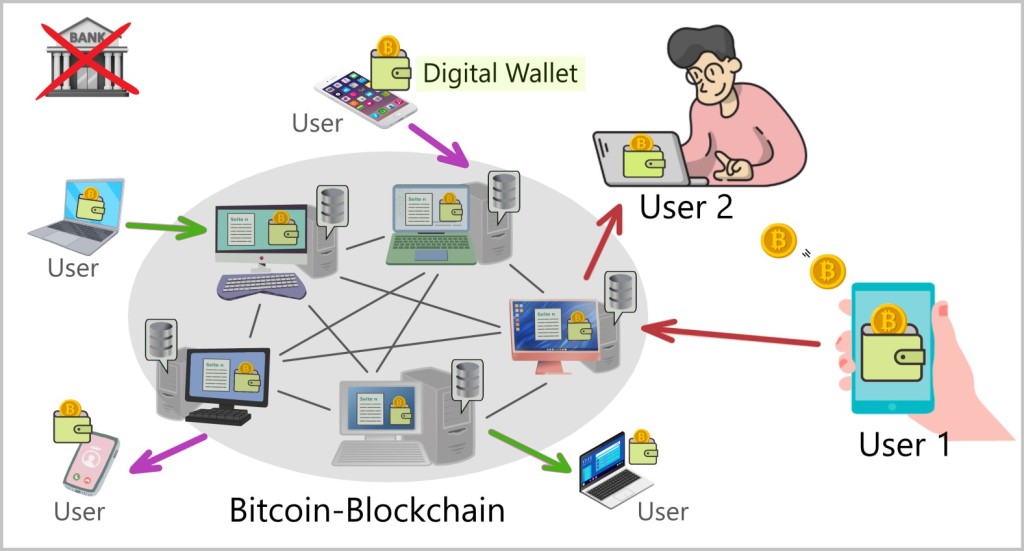
Due to its decentralized architecture, there is no single computer responsible for managing the ledger (see Fig. 21). Instead, every computer that is part of the blockchain system owns a copy of the ledger. Bitcoin uses a transparent ledger that allows every user to see all transactions and balances at any time. However, the owners of the balances and the senders and recipients of transactions are not directly identifiable. This makes Bitcoin pseudonymous, as all information is open, transparent and traceable, but the identities of the parties involved are not fully disclosed.
Bitcoin is purely digital and does not exist in physical form like traditional coins or banknotes. Instead, ownership of Bitcoin represents the right to access certain records in the ledger, known as the blockchain, and to send Bitcoin between different addresses. Since Bitcoin is not controlled by a government, authority or bank, the owner retains full control over their Bitcoin money. Only the rightful owner has access to their Bitcoin balance in their digital wallet and can dispose of it.
Digital wallets are electronic wallets that allow users to securely store, manage and transact with digital currencies such as cryptocurrencies. They work in a similar way to traditional wallets, but for digital currencies, and offer functions such as sending and receiving coins, viewing account balances and managing transaction histories.
By enabling direct payments between users without intermediaries such as banks, Bitcoin makes international transactions in particular much easier. This eliminates bank fees and the hassle of dealing with exchange rates.
Bitcoin, like gold, is designed to be scarce as there is a maximum cap of 21 million Bitcoins that can ever be created. For this reason, some investors view Bitcoin as a long-term investment and a hedge against inflation.
A concise yet thorough explanation of what Bitcoin is and how to use it can be found in the video „Bitcoin’s explanation: Understanding Bitcoin in just 12 minutes” by Finanzfluss.
Let’s summarize the key advantages and disadvantages of Bitcoin:
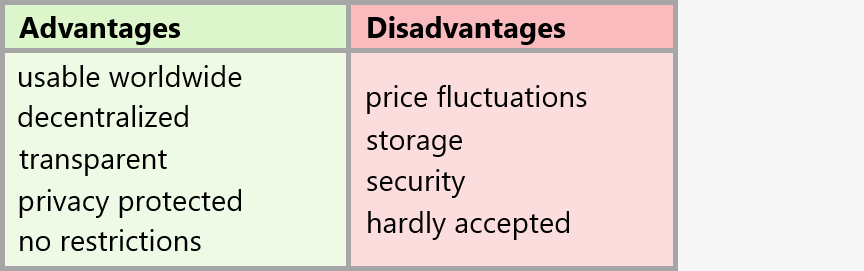
In most countries, Bitcoin, like other cryptocurrencies, is not considered a legal tender. Instead, Bitcoin is often seen as a digital asset or alternative payment method. This means that the use of Bitcoin for transactions is voluntary and not required by law. However, some countries have recognized cryptocurrencies as a legal payment service or financial instrument, but not as legal tender in the traditional sense. (El Salvador is currently the only country where Bitcoin is considered legal tender, with limited success. The introduction of Bitcoin as legal currency has not improved the situation for financing and stabilizing public finances in a country where large portions of the population live below the poverty line.)
For this reason, the use of cryptocurrencies as a medium of exchange, one of the three main functions of money, is often severely restricted. This often results in cryptocurrencies having to be exchanged for a legally recognized fiat currency. This is usually done via a cryptocurrency exchange or an online trading platform. The latter often require user verification during the registration process, which at least partially compromises the advertised privacy when using cryptocurrencies.
As a virtual currency, Bitcoin does not represent real assets such as cash flow, stocks, company shares, or gold reserves. The value of a unit is determined solely by supply and demand, which can lead to significant price volatility.
In January 2024, the first so-called Bitcoin spot ETFs were introduced in the USA. These ETFs (Exchange-Traded Funds) are investment funds that are traded on an exchange and use Bitcoin as the underlying asset. They create a link between cryptocurrencies and the traditional financial world. Bitcoin ETFs offer institutional investors a legal and regulated way to participate in cryptocurrency, even if they may not be able to invest in Bitcoin directly. By buying a Bitcoin spot ETF, you are essentially buying a stake in the cryptocurrency itself.
The decision by BlackRock, the world’s largest asset manager, to enter the Bitcoin spot ETF business has already caused a stir. BlackRock manages a total of 9 trillion US dollars in assets. Even if the company were to invest just one percent of its assets in Bitcoin, this could have a significant impact on the Bitcoin price (Figure 23).

The high volatility, limited acceptance, and certain technical hurdles in handling disqualify Bitcoin as a reliable medium of exchange or store of value for large segments of the population.
What was presented to the public in 2009 as a „grassroots democratic” alternative to the „elitist” traditional banking and financial system has essentially evolved into speculation fifteen years later. Speculation involves short-term investments, where the period between buying and selling a stock is relatively brief. A speculator relies on short-term fluctuations in the stock market and attempts to predict stock price movements accurately in order to trade accordingly.
Due to the limited supply of bitcoins, the price and hence the confidence in Bitcoin can be influenced by large institutional investors such as BlackRock or Grayscale, both partners of the World Economic Forum (WEF). It is noteworthy that BlackRock also emerged as winners during the 2007-2008 financial crisis – an irony of fate in the financial world.
According to the WEF document Understanding the macroeconomic impact of cryptocurrency and stablecoin economics, „these digital currencies could be potential drivers of financial stability, equity, innovation, and market incentives for environmental sustainability”.
3.6. Tether (USDT) – Safe Haven (In God We Trust)
Tether is a cryptocurrency based on blockchain technology and designed as a so-called stablecoin. Its goal is to provide a stable value compared to other cryptocurrencies, which experience significant fluctuations in value. Typically, Tether’s value is pegged to an established fiat currency such as the US dollar, with 1 Tether usually equaling 1 US dollar. Tether Limited is the company behind Tether.
The aim is to combine the benefits of cryptocurrencies (see Fig. 22) with the stability advantages of a fiat currency. An obvious use case would be as a medium of exchange. However, stablecoins like Tether are rarely accepted for everyday purchases in the real world, as only governments can declare a currency as legal tender. Nowadays, stablecoins are mainly used on cryptocurrency exchanges. Traders use them to exchange volatile cryptocurrencies for stable ones and thereby mitigate risk. For example, investors who have invested in volatile Bitcoin and do not want to risk the Bitcoin price falling against the US dollar can simply exchange their bitcoins (BTC) for US dollar Tether (USDT) and retain the dollar value. If they later want to hold bitcoins again, they can easily exchange their USDT back into BTC. Investors can convert profits into Tether without having to leave the crypto ecosystem. They can „park” their cryptocurrencies in Tether to await value fluctuations or transfer their crypto assets without losses in value.

Tether thus assumes the function of a safe asset in the virtual crypto ecosystem. A „safe asset” is an asset that is considered a safe haven for investors, especially in times of economic uncertainty or turbulence. Such assets are usually characterized by stability, low volatility and high liquidity.
Transactions in USDT are considered both fast and cost-effective. Additionally, cross-border payments in Tether can easily transition into another target currency.
Due to these characteristics, Tether is also hailed as a bridge between the virtual cryptocurrency world and the real financial world. In the 2021 WEF article titled „Cryptocurrencies are democratizing the financial world. Here’s how”, one finds the following:
„Cryptocurrencies, such as stablecoins, which are cryptocurrencies pegged to other assets such as the US dollar, can now act as a safer and more trustworthy way of safeguarding people’s assets.
For example, if you were living in Nigeria, you would have seen your net worth drop by nearly 50% since 2016 as the Nigerian Naira dropped from roughly 200 Naira per US Dollar to nearly 400 Naira per US Dollar by the end of 2020. However, if those assets has been kept in a stablecoin like Tether (USDT), a stablecoin pegged to the US Dollar, they would have been safeguarded from any drastic devaluation.“
„Cryptocurrencies and blockchain technology, paired with the global growth of mobile and indeed internet adoption, are tempering rising financial inequalities.
And it is not inconceivable to imagine that in the coming decades, the world will have a much more democratised and accessible financial system. Financial inclusion could be achieved thanks to cryptocurrencies.“
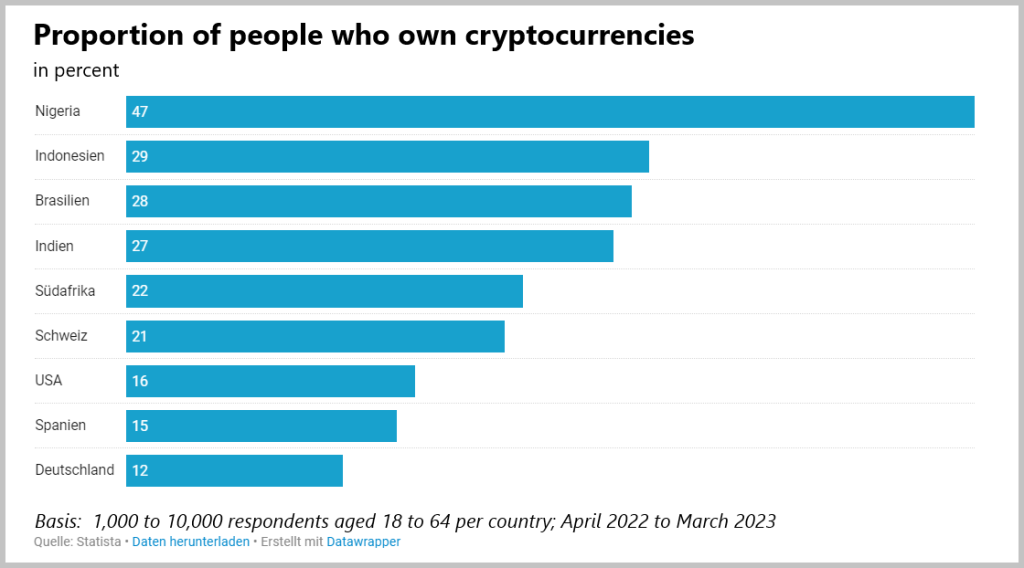
In developing countries and emerging markets in particular, where national currencies are very volatile and the banking system does not offer nationwide coverage, such concepts are gaining increasing acceptance (Figure 25).
How do stablecoins like Tether manage to keep their value stable while other cryptocurrencies are subject to strong price fluctuations?
The stability of money, whether physical or digital, relies on the trust of its users. If the market doubts the value of USDT, people will quickly sell off their USDT, leading to a price decline. To maintain this trust, companies like Tether, for example, deposit assets as collateral for their coins. These reserves serve as a guarantee that the company will uphold its promise and that its coins indeed have the specified value. In the case of Tether, each USDT is backed by US dollar reserves and other assets. In addition to fiat currencies, stablecoins can also be backed by other assets, such as gold, oil, or other cryptocurrencies.
Unlike Bitcoin, Tether (USDT) does not have its own blockchain. Instead of using its own blockchain, Tether is issued on various existing blockchain platforms. As already explained in chapter 3.3., a token is generally a digital unit that is created and issued on a blockchain platform and represents a specific value or function. In relation to Tether, USDT is a token that represents the value of one US dollar. Each USDT token should therefore always have the value of one US dollar. These tokens are issued on various blockchains and can be stored, transferred and traded in wallets, just like other cryptocurrencies and digital assets.
USDT (Tether) can be considered a form of tokenized money. Tokenized money refers to the digital representation of traditional fiat currencies or other assets in the form of tokens on a blockchain.
A USDT token is typically generated through a deposit process at Tether Limited or one of its partner banks. A user sends a certain amount of US dollars to Tether Limited or deposits it in a special account. Upon receipt of the deposit, Tether Limited then issues the corresponding amount of USDT tokens backed by the deposited US dollars.
For example, if you have a multi-chain wallet, you can transfer your USDT tokens to it. A multi-chain wallet supports multiple blockchains and allows you to manage different cryptocurrencies on different blockchains in a single wallet. This allows you to carry out transactions on the supported blockchain networks.
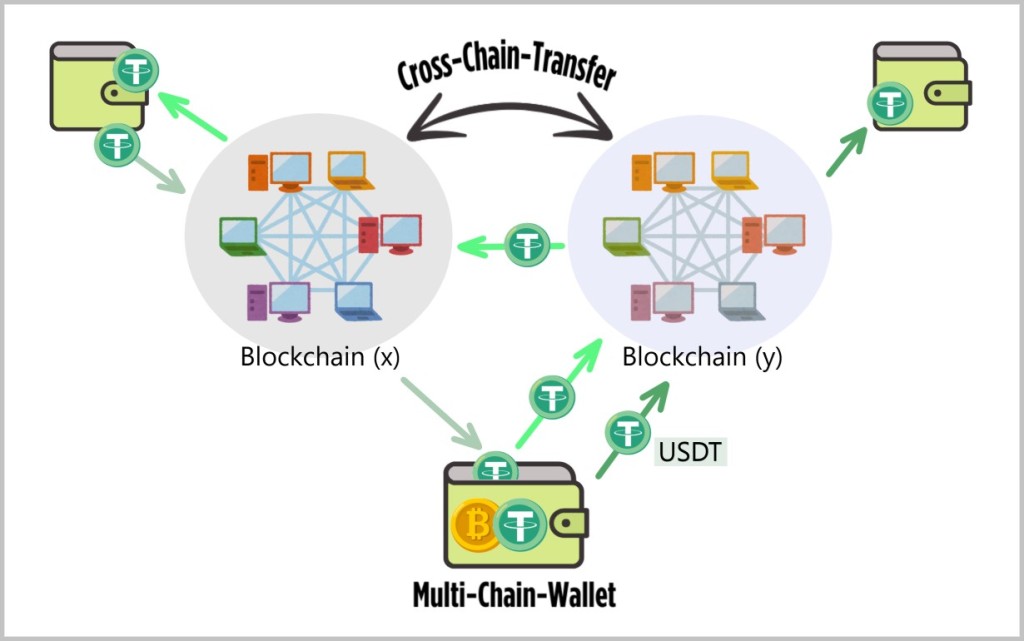
By being able to use Tether on different blockchains, users can benefit from the different functions of the individual networks.
By being supported on various blockchains, Tether also increases the liquidity and interoperability of the currency, as it can be exchanged between different blockchain platforms. This contributes to the further adoption and acceptance of Tether, allowing users to leverage the benefits of a stable digital currency in different contexts.
However, there are also disadvantages to this structure. The company ensuring the security of the stablecoin assumes the role of a private „virtual central bank”. In the case of USDT, this is Tether Limited. In addition to the risks of misappropriation and the difficulty in proving that the company has enough assets to back the amount of coins in circulation, the question arises of how long-term adequate security can be ensured, thus maintaining public trust.
Ultimately, the question of regulation arises: Will regulatory authorities allow companies to create an asset that resembles legal tender without any supervision?
Chainalysis – Making the invisible visible
From today’s perspective, the use of stablecoins seems to be tolerated as long as it is limited to specific geographic areas and clear conditions of use are established. A report by Chainalysis titled „The 2021 Geography of Cryptocurrency Report” describes how cryptocurrencies are being introduced in some Latin American countries in response to economic hardships. The aim is to help people in Latin America mitigate their economic difficulties through the use of stablecoins. One reads:
„So many Latin American countries have economic instability, so the people there aren’t really interested in trading cryptocurrency or getting exposure to Bitcoin because it’s going to $80,000… People are trying to survive, so they need the ability to switch between their local currency and cryptocurrency to preserve its value.… Remittances are another driving force behind Latin American cryptocurrency adoption. This isn’t entirely surprising, as traditional, fiat currency remittances are hugely important to many Latin American countries. According to the World Bank, incoming remittances in 2020 represented 2.4% of GDP for Latin America as a whole, more than any other region the organization tracks besides South Asia. In countries like El Salvador and Honduras, remittances represent over 20% of national GDP. … 35% of Venezuelan households receive remittances from abroad. The Venezuelan bolivar is essentially worthless due to hyperinflation. Cryptocurrency provides a way for Venezuelans who have left to send money back, and the receivers can then hold that money in a more stable currency.”
GDP stands for gross domestic product. It is an important economic indicator that measures the total value of all goods and services produced within a country’s borders during a given period, usually a year. GDP is often used to evaluate and compare a country’s economic performance.
Chainalysis is a blockchain data platform that provides tools and research for government agencies and financial institutions. Its goal is to shape a global economy based on blockchains.
„We are paving the way for a global economy built on blockchains. Businesses, banks, and governments use Chainalysis to make critical decisions, encourage innovation, and protect consumers.”
A 70-second introduction to Chainalysis can be found here:
This brief introduction demonstrates very clearly that user privacy is essentially based on the concept of „pseudonymity”. A kind of asymmetrical protection of privacy is applied. While the majority of users do not know the true identity of a person behind a pseudonym (e.g. public address/key) and thus privacy (e.g. private address/key) is maintained, it is possible for a select group of people or institutions to determine the true identity through special knowledge and access to appropriate technologies. Therefore, pseudonymity does not offer complete anonymity, but provides a degree of privacy from the general public while allowing traceability for certain authorized parties.
This is an important point. The ability to determine the identity of a person behind a pseudonym contributes in some ways to the further concentration of knowledge and power. Individuals or organizations with the resources and technical ability to decode identity can thereby exercise increased control over the information and actions of those using pseudonyms. This can be particularly problematic if this power is in the hands of a few powerful institutions or governments, which can lead to an imbalance in terms of data protection and individual freedom.
In this regard, it’s important that the use of pseudonymity in society and in technological systems is accompanied by appropriate protective mechanisms and privacy regulations to prevent the abuse of knowledge and power and to preserve individual privacy. In most cases, governmental or regulatory institutions are responsible for establishing and enforcing privacy regulations and protective mechanisms against data misuse. These institutions are often established by the respective governments.
The use of stablecoins as virtual „safe assets” in economically challenging situations has sensitized large parts of the population in affected regions to the use of digital currencies and, in a way, prepared them for it. As a result, technological infrastructures have been developed in the background, and the acceptance and handling of virtual „safe assets” as a form of tokenized money have been tested and evaluated. At the same time, corresponding analysis and monitoring tools have also been tested and improved to ensure the necessary depth of data extraction.
The document „The Current State of Central Bank Digital Currencies (CBDCs) in 2023” by Chainalysis provides further insights into how the crypto ecosystem serves as a „sparring partner” or „training ground” in the ongoing development and evolution of the fiat financial system.
„Blockchain technology has made digital payments faster and easier than ever, and allowed for the proliferation of new cryptocurrencies for different use cases, with unique traits like decentralization, immutability, pseudonymity, and more. These innovations have demonstrated that global finance is ripe for change – and governments have taken note. Central banks across the globe have already begun remodeling financial systems for the internet age.”
3.7. Libra – The King is Dead, Long Live the King!
What would happen if a stablecoin was backed not just by one company, but by a consortium of companies including Master Card, Visa, Stripe, eBay, PayPal, Vodafone and Facebook (Meta)?
Here is a summary of a few key figures:
MasterCard and Visa: Both are the world’s best-known credit card companies offering payment services for credit and debit cards. They facilitate the electronic transfer of money between consumers, merchants and financial institutions worldwide and enable transactions in various currencies. According to statistical data for 2023, Visa leads with over 4.3 billion cards worldwide, followed by Mastercard with 3.3 billion cards. [Free credit card]
Stripe: Stripe is a leading financial technology company that provides online payment solutions and payment processing platforms for businesses. Today, millions of businesses of all sizes use Stripe to accept payments online and in person, make payouts, automate financial processes and ultimately increase revenue.
eBay: eBay is one of the world’s largest online marketplaces where people and businesses can buy and sell goods and services. eBay provides a platform for e-commerce where millions of transactions take place every day. In 2023, 132 million active customers were counted on eBay. [statista]
PayPal: PayPal is a well-known payment service provider that enables consumers and businesses to send and receive money online. It offers secure payment solutions for e-commerce transactions and enables users to transfer money electronically, pay bills and make online payments. The number of active accounts of the online payment service PayPal amounted to 426 million in the fourth quarter of 2023. [statista]
Vodafone: Vodafone is a global telecommunications company headquartered in the UK. The company is active in many countries, operating mobile networks in over 20 countries and fixed-line or broadband services in many more. Vodafone is known for its global telecommunications services, innovative technologies and commitment to providing connectivity and communications solutions to individuals, businesses and governments around the world. Vodafone currently has over 300 million mobile customers worldwide.
Facebook (Meta): Facebook is a global social network and one of the largest technology companies in the world. Facebook’s main goal is to connect people and facilitate the exchange of information, content and ideas. Facebook also offers advertising and marketing services for companies, enabling them to advertise their products and services in a targeted manner and engage with their target audience. In the fourth quarter of 2023, the number of daily active users on Facebook was just under 2.11 billion. [statista]
The combination of substantial financial resources and cutting-edge technologies within a global network of more than 4 billion users could result in privately issued cryptocurrencies seriously challenging or even partially displacing central bank and commercial bank money as a means of payment. Consequently, central banks might cede control over the payment system to a private corporate group whose network effects could be extensive, powerful, and potentially harmful. Ultimately, this could undermine monetary sovereignty and jeopardize financial stability.
In June 2019, this very scenario threatened to become reality when Facebook (now Meta) announced the project called Libra. Libra was to be a cryptocurrency backed by assets, i.e. a stablecoin. This was to serve as a means of payment for members of the global Libra Association network, which included the companies mentioned above. [wikipedia]
Was this a real revolution or just a serious message? And if so, by whom was it addressed to whom?
As essential members of the Libra Association, Facebook (Meta), Visa, MasterCard, Stripe and Paypal are all partners of the World Economic Forum (WEF).
The World Economic Forum is the international organization for public-private cooperation. It provides a global, non-partisan and non-profit platform for meaningful connections between stakeholders to build trust and initiatives for cooperation and progress. In a world characterized by complex challenges, the World Economic Forum engages political, business, academic, civil society and other community leaders to shape global, regional and industry agendas. The WEF aims to foster international cooperation to address the great challenges of our time and plays an important role in shaping global political, economic and social developments. [weforum]
On July 15, 2019, Facebook announced that the currency would not be launched until all regulatory concerns had been addressed and Libra had the necessary approvals. On September 18, 2019, during a meeting with leading Senate Democrats, Mark Zuckerberg stated that Libra would not be introduced anywhere in the world without prior approval from U.S. regulators.
A revolution truly looks different. The World Economic Forum member’s message to policy makers and central bankers worldwide that it is time to practically implement the extensive knowledge and experience gained from the crypto ecosystem over the last 10 years into the further development of the fiat financial system was quickly taken up.
On the one hand, the Libra initiative met with considerable resistance from governments, central banks and regulatory authorities worldwide. They expressed concerns about the potential impact on monetary policy, financial stability, anti-money laundering and data protection. In response to this opposition and regulatory pressure, the project was formally renamed and restructured. Within just 6 months of the project’s announcement, Visa, MasterCard, Stripe, PayPal, eBay and Vodafone withdrew from the initiative. Meta finally abandoned the project in January 2022, citing regulatory hurdles. Regulatory authorities around the world intervened and banned privately issued cryptocurrencies as legal tender. [wikipedia]
On the other hand, the message led to the recognition that the introduction of central bank digital currencies (CBDCs) is essential for the further development of the fiat financial system. The fact that this is a strategic decision with global implications is highlighted by the Atlantic Council’s involvement in coordinating this process.
The Atlantic Council is an independent, nonpartisan think tank and forum for policy discussion focused on transatlantic relations. The Atlantic Council addresses a wide range of issues, including security policy, international relations, economic issues, technology, energy, the environment, and global governance. Atlantic Council members include political leaders, government officials, former heads of state and government, senior military officials, business leaders, academics, and other public figures. [atlanticcouncil]
The Central Bank Digital Currency (CBDC) Tracker, published by this think tank in July 2021, provides an overview of the rapid development of digital central bank money worldwide. The interactive database now covers 130 countries, which together represent 98% of global gross domestic product (GDP).
The discussion is no longer about whether CBDC will be introduced in the individual countries, but rather about when and how this will happen.
3.8. Ethereum – Code is Law
In chapter 3.2, we learned that blockchain technology was created by combining existing technologies such as distributed ledger technology (DLT), cryptography and consensus algorithms. The result is a system that can make decisions without a central authority. Bitcoin is a concrete example of the application of such a system (see chapter 3.5.). Blockchain technology can be seen as a system on which various applications and programs can be developed and executed. A currency such as Bitcoin is just one possible application of this.
With technology that can decentralize the handling of money, people are beginning to explore what other applications or tasks that are currently centralized could be better accomplished in a decentralized system. But a truly decentralized system requires a large network of computers to run it. In the beginning, the Bitcoin blockchain was the only network in existence, and it was quite limited. This was because the programming language used for Bitcoin is specifically defined for this one application. It only has a small set of commands that the computers in the network can understand and execute (e.g. who sent how much money to whom).
A programming language is a formal language that is used to write instructions that can be executed by a computer. It enables a programmer to design and implement algorithms to solve specific tasks or problems.
To solve versatile and complex tasks, one needs a „complete” programming language and a specialized computer network that understands this language. A programming language is considered „complete” if it exhibits the following characteristics:
- It can store information and work with it.
- It can make decisions and do different things depending on what is happening (for example, „if this, then that”).
- It can perform certain actions repeatedly as long as necessary (like a loop).
- It allows certain additional tasks to be defined and executed whenever they are needed.
If a programming language possesses all these properties, it can perform any possible computation. Consequently, it can solve any computable function or problem.
Let’s say you want to create your own decentralized program, similar to Bitcoin, at home. To do this, you first need a deep technical understanding of the underlying concepts of cryptocurrencies such as blockchain, consensus algorithms, cryptography, transactions and mining. You need to master a programming language that allows you to implement the consensus algorithm, transaction processing, wallets, network functions and other necessary components in a software algorithm. Last but not least, you need to set up a huge network of computers to run this software. That sounds like a „Mission Impossible”, doesn’t it?
In such a situation, Ethereum can be at your side. Ethereum is an open-source blockchain platform that allows developers to create and run decentralized applications (DApps). It was conceived by Vitalik Buterin in 2013 and officially launched in 2015. If you want to create a decentralized program that no single person controls – not even you, even though you wrote it – all you need to do is learn the Ethereum programming language Solidity and start coding. Solidity is considered a „complete” programming language that enables the development and execution of complex applications on the Ethereum blockchain. The Ethereum platform runs thousands of independent computers, which means that it is fully decentralized. Once a program is deployed on the Ethereum network, these computers, also known as nodes, ensure that it is executed as intended. Ethereum forms the infrastructure for the global operation of DApps.
In Chapter 3.5., we explained the Bitcoin blockchain using the analogy of a public notebook (ledger) that can be viewed by anyone. All transactions that have ever taken place are recorded in this ledger. Each page of this ledger corresponds to a block that contains a list of transactions, such as money transfers from one person to another.
Like Bitcoin, the Ethereum network can be used as a platform for cryptocurrencies. Within the Ethereum ecosystem, Ether serves as a cryptocurrency. Ether is a token that was created and is used specifically for use on the Ethereum platform. As the primary means of payment of the Ethereum network, Ether enables transactions between users. It can be used to transfer value or make payments for services and products. In fact, the cryptocurrency function of Ethereum is only of secondary importance.
Ether is primarily used as a fee charged for every computation that occurs within the Ethereum network in connection with a transaction. In the Ethereum ecosystem, nothing is free! These fees make Ether the primary requirement for creating or using DApps (decentralized applications) on the Ethereum blockchain. The collection of fees serves to protect the Ethereum network from congestion. As mentioned earlier, Ethereum utilizes a complete programming language that enables complex computations. Without fees, a malicious actor could easily attempt to disrupt the network by executing an infinite loop within a transaction without being penalized. Fees ensure that such actions incur costs, deterring potential attackers and safeguarding the network against deliberate attacks.
Ethereum allows people to connect directly with each other without the need for a central authority. It is a network of computers that connect to form a powerful „decentralized supercomputer”. The combined computing power of the network nodes can be used to perform complex calculations or provide resources for decentralized applications (DApps) running on the platform. In this way, Ethereum can support a variety of use cases without being controlled by a central instance.
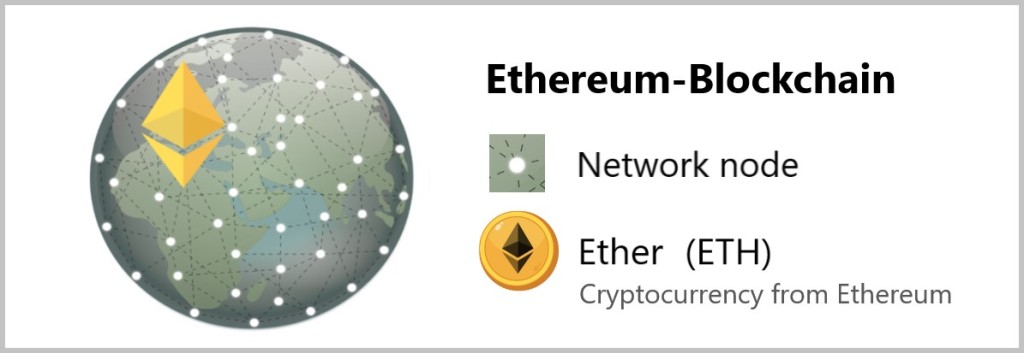
„Ethereum is a protocol for human coordination. Coordination is a game, but not one that is played to win. Coordination is more like tending a garden, where one works only that the garden may continue to thrive.“
ethereum foundation
In the Ethereum worldview, human coordination is seen as a game that follows certain rules. These rules are encoded in „Smart Contracts”. A Smart Contract is essentially like a digital contract, an automated contractual solution that executes specific tasks once certain criteria are met.
To make a Smart Contract accessible to end-users, DApps are necessary to provide a user interface through which users can interact with Smart Contracts. DApps combine a Smart Contract and a user interface, thus assuming the role of mediating between the user and the Smart Contract. Without a DApp, it would be difficult for most users to utilize a Smart Contract, as it requires technical knowledge and the ability to interact directly with the blockchain.
A DApp ensures that users can provide the necessary information to execute transactions or trigger actions in the Smart Contract, and it presents the results or the current state of the Smart Contract in an understandable manner for the user.
Both smart contracts and DApps are written using the Solidity programming language. Solidity is a programming language developed specifically for the creation of smart contracts on the Ethereum blockchain. By using Solidity, developers can write smart contracts that define the rules and logic of the DApp and have them executed on the Ethereum blockchain.
To better understand this process, one can examine the types of accounts in the Ethereum network.
Account types in the Ethereum network
There are two types of accounts on the Ethereum network:
Externally Owned Accounts (EOAs): These accounts are created and used by users of the Ethereum network. They can hold Ether (Ethereum’s cryptocurrency) and carry out transactions between external accounts. EOAs have an address and a private key. Possession of a private key means control over access to the contents of the account and authorizes the user to initiate transactions. The EOA is managed via an Ethereum wallet. The Ethereum wallet can be seen as a gateway to the Ethereum system. It holds your keys and can generate and transfer transactions for you.
If a user wants to create a DApp, they can use the Ethereum programming language Solidity to write so-called smart contracts. As described above, these smart contracts represent the program logic according to which decentralized applications (DApps) are operated on the Ethereum platform. Once the smart contract has been created, it is translated into „bytecode”, a language that computers can understand. The smart contract prepared in this way can then be registered in the Ethereum blockchain, which requires the creation of a special transaction. Once this transaction has been validated, the bytecode of the smart contract is stored in the blockchain. As soon as the contract is entered in the blockchain, it receives an Ethereum address (similar to wallets). This creates the second account type in Ethereum – the contract account.
Contract accounts: Contract accounts are special accounts that contain the bytecode of smart contracts or DApps. These accounts also have an address, but do not have a private key. When a user sends a transaction to a contract account, the code defined in the smart contract is executed. This allows users to trigger certain actions or send instructions to the smart contract to perform various functions. Transactions to contract accounts can contain Ether, data or both. If they contain ether, these are credited to the contract account. If they contain data, these can be used when executing a function of the contract.
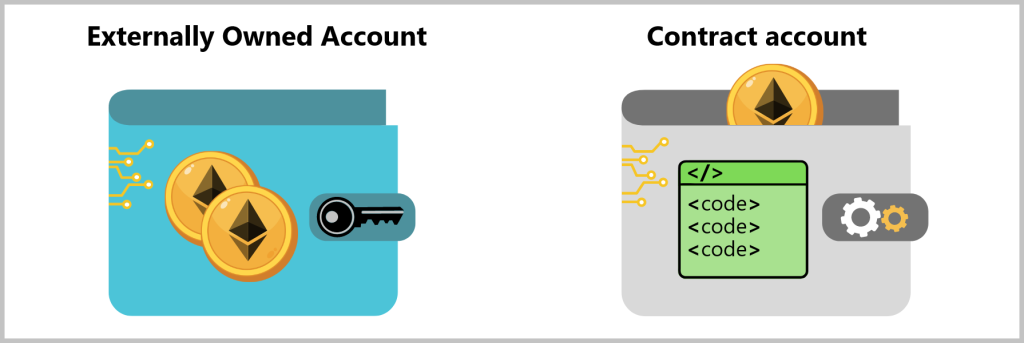
Transactions on the Ethereum network
It is essential to understand the basic difference between Externally Owned Accounts (EOAs) and contract accounts. An EOA can send messages to other external accounts or contract accounts by creating and signing a transaction with its private key. A transaction between two EOAs is simply a transfer of value. However, when a message is sent from an EOA to a contract account, it triggers the contract account’s code and allows it to perform various actions such as token transfers, writing to internal storage, generating new tokens, performing calculations, etc.
Unlike EOAs, contract accounts cannot initiate new transactions on their own. Instead, they can only send transactions in response to other transactions (from an EOA or contract account) that they have received.
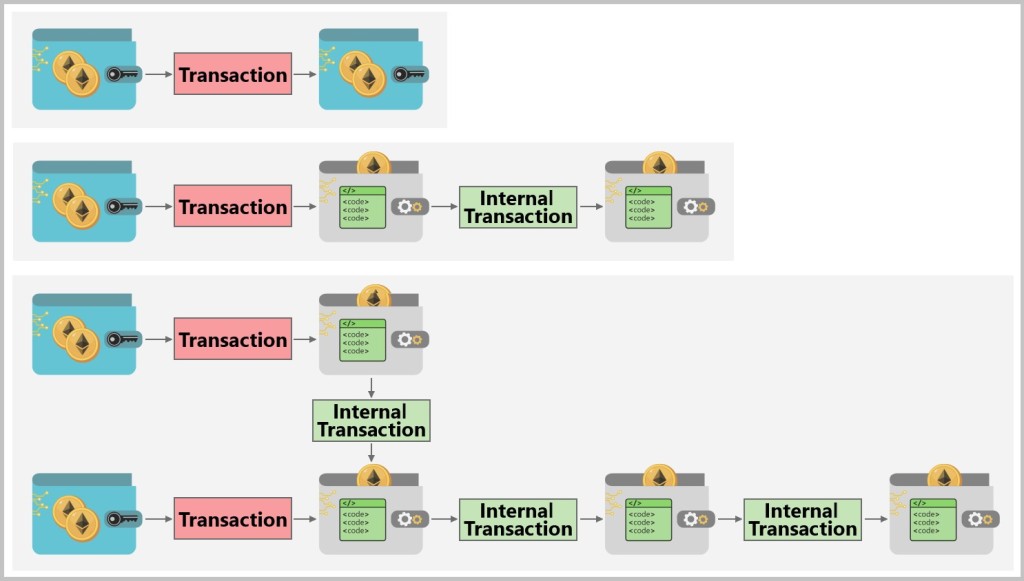
Every action that takes place on the Ethereum blockchain is always initiated by transactions sent from externally owned accounts.
The Ethereum blockchain works like a machine based on transactions. Depending on the instructions and inputs given to it, it changes its state. In computer science, the term „state machine” refers to a system that goes through different states and switches between these states depending on input. For example, when a new contract account is created or Ether is transferred for transactions with an existing contract account, the state of this global computer changes by recording the transaction and updating the balances of both the externally owned and contract accounts.
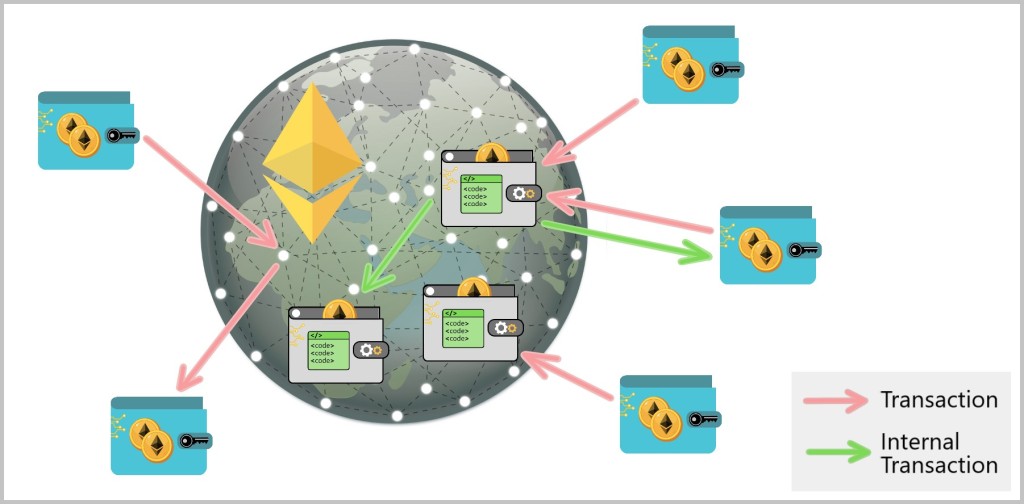
Ethereum’s state machine can be described in simplified terms as follows: It starts with a „Genesis state”, similar to a blank sheet of paper, before transactions take place. When transactions are executed, this Genesis state changes to a final state. This final state represents the current state of Ethereum at any point in time.
The state of Ethereum comprises millions of transactions grouped into blocks. Each block contains a collection of transactions and is chained to its previous block.
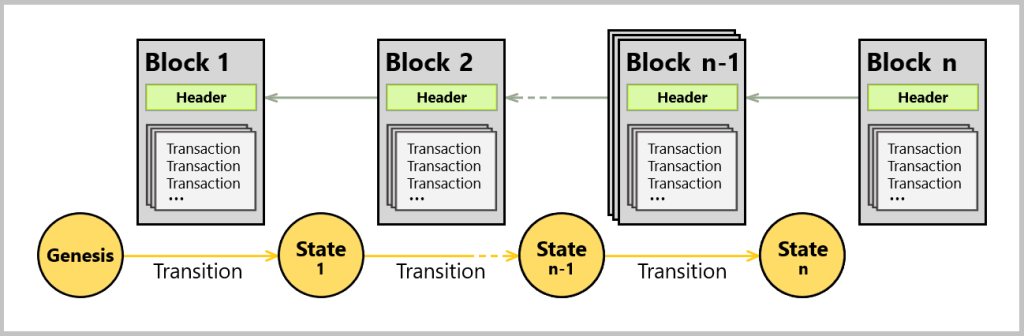
To enable the transition from one state to the next, a transaction must be valid. To be considered valid, a transaction must go through a validation process known as mining or proof-of-work. Mining is a process in which a group of nodes (i.e. computers) use their computing power to create a block of valid transactions. Each time a miner successfully validates a block, new Ether tokens are generated and paid out to them. The basic principles are similar to those described in Chapter 3.2.
CODE IS LAW
Smart contracts are stored on the Ethereum blockchain, which means they are secure and immutable. The rules and conditions of the contract cannot be altered. In the Ethereum blockchain, all transactions and state changes are transparent and traceable.
Anyone can check the transaction history of a specific smart contract and retrieve the current status by checking the corresponding data in the blockchain.
In the video „CODE IS LAW? Smart Contracts Explained” by Finematics, the term „smart contract” is explained in detail yet in a way that is easy to understand.
Let’s take a closer look at some aspects of smart contracts. As mentioned in the video above, a smart contract covers all key areas of a contract: from the identification of the contracting parties, to the subject matter of the contract, to performance, obligations, terms and duration, as well as administration and enforcement. A smart contract on the Ethereum platform is absolutely precise. It follows the pre-programmed logic down to the smallest detail and is executed deterministically.
Deterministic refers to a concept used in various disciplines such as mathematics, philosophy, computer science and physics. It essentially means that an event or series of events is completely predictable, without chance or uncertainty. In computer science, „deterministic” refers to programs or algorithms that always produce the same result given a set of inputs. This means that the execution of a deterministic algorithm always leads to an unambiguous and predictable result, regardless of other influencing factors. However, the real world is often influenced by various, sometimes unpredictable factors. In many cases, deterministic models are only an approximation of reality.
Since the smart contract is stored on the Ethereum blockchain, it practically allows for no retroactive changes. This ensures that all executions of the contract are handled with absolute precision, guaranteeing that the contract performs exactly as the author intended. This aligns with the principle of „Code is Law”. A smart contract on Ethereum possesses ultimate authority, and no one can override the contract.
The execution of smart contracts on a decentralized platform opens up new perspectives for shaping not only the financial system but also for implementing specific political agendas. This development can serve as a foundation for innovative financial services and have significant impacts on transactions both from the government to the citizen (Government-to-Citizen) and from citizens to the government (Citizen-to-Government).
3.8.1. Chainlink – Oracles – mediators between the gods and humans
Smart contracts are contracts that are based on and dependent on data. The provision of correct data is crucial to ensure that the agreement is executed exactly as expected. The accuracy of the data directly influences the results of a smart contract.
It is important to understand that blockchains have certain isolating properties within the World Wide Web. What are the reasons for this?
Blockchains are extremely secure and reliable due to certain design principles. A blockchain achieves consensus by using data that is already stored in its own ledger. The blockchain’s ledger is considered trustworthy because it uses decentralization to validate all data redundantly using all nodes in the network. Decentralization also ensures the integrity of the consensus algorithm, as changes to the protocol rules are only possible with the consent of a significant portion of the network (e.g. 51%). These properties provide strong guarantees for the determinism of computations and data storage, especially in highly decentralized networks.
However, blockchains are less suitable for answering questions that require subjective assessments or use external data that is not easily accessible to every node in the network. For example, questions such as „What is the current EUR-USD exchange rate?” or „What is the weather like in Berlin?” could lead to different answers depending on the data source used and the time of the query. As a result, the question arises as to which answer should be considered the correct one and how its accuracy can be verified. Furthermore, any change or adjustment to the blockchain network’s data sources requires extensive coordination to ensure that all network nodes agree and update their software accordingly.
For this reason, blockchains are not able to independently establish a connection to real data and events.

Smart contracts and Dapps running on the Ethereum blockchain can only directly access data that exists on the Ethereum blockchain. As the Ethereum ecosystem is still at an early stage of development and due to the specific design principles of blockchains, the amount of validated data that can be used directly by smart contracts is relatively limited. The main focus is on various areas, including:
- Development of decentralized financial services (DeFi) with cryptocurrencies
- Applications that focus on digital property
- Gaming
- Metaverse
- Social Networks
- Decentralization of developer tools as a basis for further technological developments
This is the dilemma: most of the data from the real world is not on the blockchain. Without access to this data, the use of smart contracts would be severely limited. In order to be able to use smart contracts in everyday life, they require external connectivity to communicate with other systems and confirm the occurrence of real events. This in turn entails risks and challenges, particularly with regard to the security and trustworthiness of the data. The benefits of using smart contracts therefore conflict with the difficulties of integrating external data.
This is where the so-called Oracle services come into play.
In mythology, an oracle refers to a divine or spiritual entity that serves as an intermediary between the gods and humans and as an entity that acts as a transmitter of information.
In the blockchain context, oracle services are external services or protocols that connect smart contracts with data or information from the real world. Since smart contracts on blockchain platforms such as Ethereum cannot directly access external data sources, oracle services are required to close this gap.
Oracle services act as an intermediary between the blockchain and external data sources such as APIs, IoT devices, traditional databases or other blockchain networks. They collect and deliver real-time data or events to smart contracts so that they can automatically execute actions based on this data.
An API (Application Programming Interface) is an interface that makes it possible to retrieve data from an external service or system. This enables seamless integration of external data into applications and facilitates the development of applications that rely on up-to-date information.
An IoT (Internet of Things) device is a physical device or machine that is connected to the internet and can send and receive data via the internet. The use of IoT devices enables the automation, monitoring and optimization of processes and systems in various areas, which can lead to efficiency gains, cost savings and new opportunities for innovation.
For example, an oracle service can deliver information such as weather data, stock market prices, the delivery status of parcels or the results of sporting events to a smart contract. This makes it possible for smart contracts on the blockchain to access up-to-date information and react accordingly without having to rely on manual input from users.
Oracle services are therefore crucial for the functionality and benefits of smart contracts in use cases that rely on real-world events or external data.
Oracles respond to requests from smart contracts for off-chain data. They retrieve this data from external systems and convert it into a format that can be read by the blockchain. In the process, the data is validated and a cryptographic proof that certifies the performance of the Oracle service is created. Depending on the use case, the Oracle off-chain can perform calculations based on the available data. The data prepared in this way is then transferred to the blockchain for further processing by the smart contract. If the smart contract needs to transfer information to off-chain systems, the Oracle converts it back into a readable format for the respective external system and sends it to the external system. A schematic representation can be found in the following figure.

Smart contracts that access off-chain data are also referred to as hybrid smart contracts. This distinction is not accidental and is related to the development of the World Wide Web (WWW). The individual development stages of the WWW are summarized in the following illustrations.
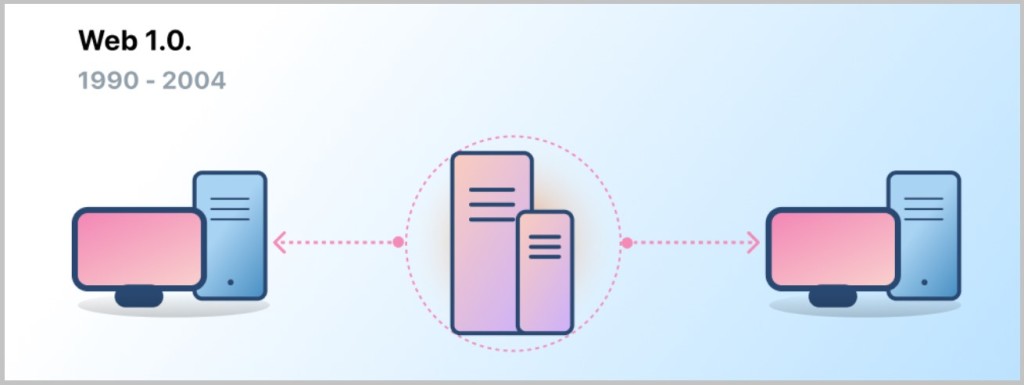
In Web 1.0, the internet consisted mainly of static websites owned by companies. There was little interaction between users and individuals rarely produced content. This led to it becoming known as the „read-only Web”.
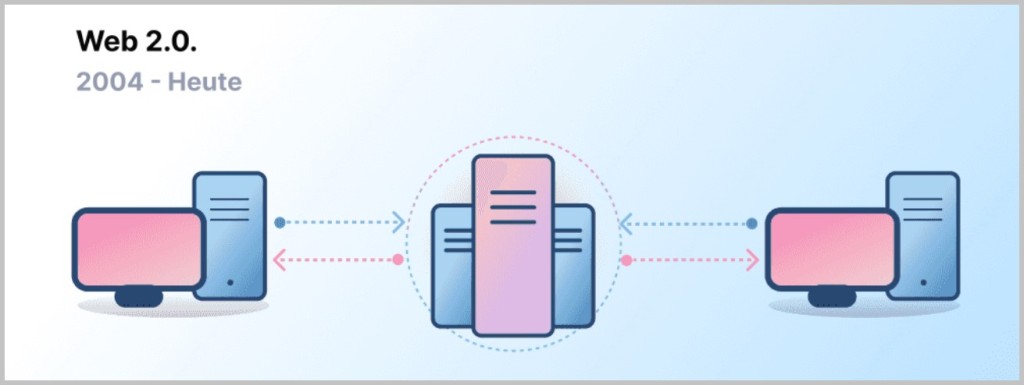
With the development of Web 2.0, the internet shifted to a „read-write Web”. Companies began to offer platforms for the exchange of user-generated content and interaction between users. However, some large companies began to control a disproportionate share of the traffic and value generated on the internet as more and more people went online. This means that most of the Internet that people know and use today is based on trust in a handful of private companies acting in the public interest.
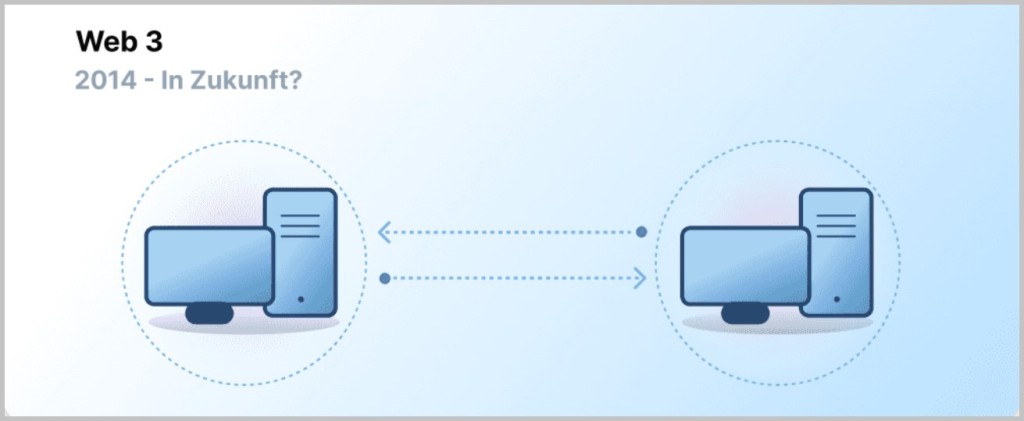
The term Web 3.0 was coined by Ethereum co-founder Gavin Wood shortly after the launch of Ethereum in 2014. A central feature of Web 3.0 is decentralization, in which power and control are transferred from centralized institutions to users and the community. Web 3.0 thus strives to develop the internet in a direction where users have more autonomy and control over their own data and interactions. Symbolically, Web 3.0 stands for „read, write, own”. Blockchain technology is often seen as a key component of Web 3.0.
A smart contract in the sense of Web 3.0 is executed on a Web 3.0 infrastructure (blockchain) and uses data that is verified decentrally (data in its own ledger).
A hybrid smart contact uses a Web 3.0 infrastructure (blockchain), but accesses data that is mostly generated in Web 2.0. This balancing act is an attempt to use the advantages of smart contracts for real-life problems.
The real world can be seen as a centralized system, although there are many decentralized elements. In most societies, there is a central authority or institutions that exercise some control over important aspects of life, such as governments, legislatures, courts, corporations and other organizations. These central authorities often have the power to make decisions, set rules and control resources. This leads to a concentration of power and influence in the hands of a few, while the majority of the population is dependent on these centralized structures. Nevertheless, there are also decentralized elements in society, such as informal social networks, local communities, independent organizations and personal relationships that are not controlled by central authorities.
Overall, the real world can be seen as a hybrid system that contains both centralized and decentralized elements. The development of technologies such as blockchain and decentralized networks can help to challenge some aspects of centralization and provide the opportunity to distribute power and control more broadly.
In some use cases, a smart contract on a blockchain with the help of oracles could only access data from another blockchain without further interaction with Web 2.0-based systems.
„Smart contracts” can also be executed on Web 2.0, although in this context they may not be as effective as on blockchain-based platforms in the context of Web 3.0. In Web 2.0, smart contracts can be implemented in centralized environments based on traditional servers and databases. These smart contracts would be managed and executed by a centralized server or authority. Although they can provide some of the benefits of automation and programmability, they lack the decentralization and transparency associated with blockchain-based smart contracts.
An example of the use of smart contracts in Web 2.0 could be an online payment system that is operated on a central server. In this case, smart contracts could be used to automatically execute payments when certain conditions are met, similar to blockchain-based smart contracts. However, the execution of these smart contracts would be dependent on the integrity and security of the central server, which does not offer the same trustworthiness and immutability as a blockchain.
For smart contracts to work as expected, the data supplied by Oracle must be correct. It is therefore crucial that the Oracle mechanism is error-free. Decentralized Oracle services are an innovative solution to the Oracle problem. These prevent data manipulation, inaccuracies and downtime. A Decentralized Oracle Network (DON) combines several independent Oracle node operators and reliable data sources to ensure end-to-end decentralization. Such a solution is offered by the company Chainlink (Figure 37).

Chainlink offers a decentralized infrastructure that makes it possible to collect data from various data sources and bring it into the blockchain. It uses a network of „oracles” that collect, validate and feed the data into the blockchain. These oracles are independent nodes that provide data and participate in the Chainlink network.
Although Chainlink uses some blockchain principles and integrates with various blockchain networks such as Ethereum, it is not a standalone blockchain. Rather, it provides an infrastructure and ecosystem that aims to collect data from external data sources and bring it into the blockchain to provide smart contracts with real-time data.
The following video provides a brief summary of Chainlink’s decentralized Oracle network solution.
To illustrate the limitless potential of universally connected smart contracts, Chainlink has compiled a list of more than 77 possible applications.
Let’s take a closer look at some of the examples mentioned by Chainlink:
External payment transactions
Nowadays, money is the usual means of valuing assets and purchasing services. Smart contracts can process payments in the cryptocurrency of their own blockchain, for example Ethereum smart contracts that accept ETH. However, many businesses and users do not want to exchange their preferred fiat currency for cryptocurrency. Instead, they prefer to use a variety of already established payment options and services. Chainlink enables the connection of smart contracts with existing banking systems. Developers can seamlessly integrate information and services such as consumer bank accounts, direct deposits and other processes from leading global banks into their algorithms. In addition, Chainlink provides access to leading credit card providers and established payment networks such as PayPal and others. Developers can now create applications that take advantage of the most popular payment methods used daily in both domestic and international retail environments.
This lays the foundation for the integration of transactions with all established digital fiat money variants such as debit and credit cards, electronic wallets or apps as well as digital deposits at commercial banks in smart contracts.
Insurances
The insurance industry today operates in an environment characterized by low trust. Policyholders have an incentive to misrepresent positive information in their applications to lower their monthly premiums, while insurers tend to delay payments and increase rates to compensate for misrepresented risk profiles. Traditional insurance companies can benefit from blockchain technology by developing advanced smart contract-based parametric insurance contracts that automatically trigger insurance premiums and payouts based on real-world data provided by decentralized oracle networks.
- Vehicle insurance
Modern vehicles are equipped with a variety of internal sensors, internet connections and even native APIs. A smart contract can use some of this data to set the rental period, unlock the vehicle doors for the renter, record the rental period, calculate the kilometers driven, determine the remaining battery charge and automate rental payments. In this way, complex rental contracts can be created for „smart cars”. In addition, new forms of insurance will be available that are triggered based on impact sensors in the vehicle, or insurance discounts based on metrics such as kilometers driven per year.
- Household contents insurance
The growing „smart home” phenomenon is leading to the proliferation of sensors and advanced security systems that automatically notify homeowners and emergency services of unusual events. These sensors can be connected to smart contracts via Chainlink oracles to create new parametric home insurance products. For example, they can detect broken pipes, fire and smoke development, malfunctioning solar panels or even burglaries to enable more direct protection from the insurance company’s alarm system.
- Health insurance
With numerous advances in biotech and IoT wearables such as smartwatches, insurance companies can create smart contracts that offer health insurance discounts or impose penalties based on a patient’s health data. Key data points could include distance traveled (exercise), body weight, heart rate and potentially more advanced biometrics as they become available in the future. Chainlink oracles can also detect data anomalies that can trigger mandatory consultations to maintain favorable insurance premiums.
Sustainability / Regenerative farming
Hybrid smart contracts, which combine the benefits of on-chain code with real-time data from IoT sensors and satellite communications, offer the opportunity to create transparent, fully traceable and automated incentive systems. These systems can directly reward individuals, businesses and governments for their efforts to promote sustainable practices and combat climate change, as well as mitigate its harmful effects. These applications can include the creation of tokenized carbon offsets, promotion of regenerative agriculture and monitoring of resource consumption to reward those who stay within their means.
These examples illustrate how your financial situation, your mobility, your living environment, your working environment and even your physical well-being can be embedded in algorithmic rules and integrated into smart contracts. Looking at this in a visionary way, the concept of „Code is Law” could soon lead to essential aspects of your life story being magically influenced by smart contracts.
3.8.2. Behind the scenes – Shadows on the wall
Chainlink works closely with the World Economic Forum (WEF). In a WEF article entitled „The missing link between blockchains and enterprises” and in a WEF white paper entitled „Bridging the governance gap: Interoperability of Blockchain and Legacy Systems”, Chainlink’s technology is positively highlighted and promoted.
The Ethereum platform is supported by the Ethereum Foundation, a non-profit organization founded in 2014. Its main purpose is to develop and promote the Ethereum platform. The Ethereum Foundation plays a crucial role in supporting the Ethereum developer community, promoting education and research in the field of blockchain and cryptocurrencies, and driving the continuous development of Ethereum technology.
The Ethereum Foundation and the World Economic Forum (WEF) also work closely together. Aya Miyaguchi, Executive Director of the Ethereum Foundation, was appointed to the WEF’s Blockchain Global Council in 2019. Together, they are working on various projects, including the question of how blockchain principles can contribute to improving environmental, social and governance (ESG) systems.
Another point of contact exists with the company ConsenSys. Joseph Lubin, the founder and CEO of ConsenSys, is also one of the co-founders of Ethereum. ConsenSys is listed as a partner organization of the World Economic Forum. In a white paper by ConsenSys titled „Central Banks and the Future of Digital Money: An Overview and Proposal for a Central Bank Digital Currency on the Ethereum Blockchain”, the following can be read:
„According to the Bank for International Settlements, over 70% of central banks are looking at issuing a digital currency on a blockchain.
CBDCs can offer a range of advantages. They can play a central role in advancing the digital asset revolution in a regulated, lower-risk and – crucialy – accessible way, helping make financial markets more efficient and accessible to all global citizens.
CBDCs can give central banks more effective, future-oriented tools to allow them to implement monetary policy in more direct and innovative ways and keep pace with technological change. CBDCs could also simplify and reduce the cost of cross-border remittances, while forming the basis for more efficient, more secure interbank payments networks. The list goes on.
Below we provide both an overview of CBDC and a concrete example of how a CBDC might be implemented on the Ethereum blockchain. We believe that Ethereum is the best-suited blockchain network for the kind of maximally secure, global-scale, interoperable settlement platforms that CBDCs require. But we are well aware that there are many other possibilities.
What is important is that central banks have come to realize the extent of the transformations that are already happening in digital currencies, and that they see the importance of embracing a significant role in bringing about this change.“
The fact that one aims to use Distributed Ledger Technology to solve essential tasks in a centralized ledger system sounds like a paradox. But more about that in the following chapters.
3.9. Interim balance
Cryptocurrencies were introduced in 2009 as an alternative, democratic option to the traditional banking and financial system perceived as elitist. Despite this ambitious vision, most crypto projects have encountered a common problem: recognition as a suitable form of payment in the real world dominated by fiat currencies. Some cryptocurrencies have proven to be extremely volatile, while their networks are often perceived as slow, cumbersome, and complex for the average user. In contrast, stablecoins are viewed skeptically due to concerns regarding the backing of the underlying cryptocurrency as well as regulatory hurdles, particularly with projects like Libra.
However, this creates an ideal test environment for exploring different aspects of the introduction of various decentralized digital currencies worldwide without significantly disrupting the existing financial system.
Distributed ledger technologies, in particular blockchain, have been tested and further developed in practice. At the same time, the use of decentralized digital currencies through digital wallets was tested by a broad population worldwide. The concept of pseudonymity, which protects privacy while making transactions transparent, was introduced. The use of virtual „safe assets” as tokenized money in economically difficult situations has significantly increased the acceptance of digital currencies in affected regions and prepared the population for their use.
Smart contracts have been used to introduce programmable functions in complex transactions. In addition, a corresponding infrastructure was set up to supply smart contracts with real-time data from the real world, extending their scope beyond crypto ecosystems.
At the same time, corresponding analysis and monitoring tools were also tested and improved in order to provide regulatory authorities with the necessary depth of data extraction.
Cryptocurrencies have contributed to raising public awareness about dealing with digital currencies and positively influencing perceptions regarding the technological evolution of the monetary system.
The design of Central Bank Digital Currencies (CBDCs) will be heavily influenced by technological innovations from the cryptocurrency world. This will be further elaborated in the following chapters.
4. CBDC – The Digital EURO – A New Star is Born

In the previous chapters, it has been emphasized that the current fiat money system faces various structural and technological challenges. The introduction of a Central Bank Digital Currency (CBDC) is seen as a crucial step in addressing these challenges. Currently, 134 countries and currency unions, representing 98% of the global GDP, are considering the introduction of a Central Bank Digital Currency.
There are two types of CBDC issued by central banks: „Wholesale CBDC” and „Retail CBDC”.
Wholesale CBDC refers to a digital currency intended for large financial institutions and institutional investors such as commercial banks and payment processing companies. This form of CBDC is typically used to facilitate interbank transactions or serve as a means of settlement for wholesale trade between financial institutions. Wholesale CBDC can make payment and settlement systems more efficient by processing transactions faster, more securely and more cost-effectively. Although wholesale CBDC is often presented as a new concept, digital central bank money has been available for wholesale transactions for decades. The discussion therefore does not focus on whether to introduce digital central bank money for wholesale transactions, but rather on possible technological changes in the provision of this money.
In contrast, Retail CBDC is intended for general use by individuals and businesses, similar to physical cash or digital money in a bank account. Retail CBDC could enable people to conduct digital transactions directly with the central bank, without the need for a bank account at a commercial bank. Retail CBDC aims to enhance general access to digital payment methods and promote the use of digital transactions by individuals and small businesses.
In the following considerations, we will focus on the Digital Euro as a representative of CBDC.
In June 2021, the European Central Bank (ECB) announced the „Digital Euro”. In July of the same year, the ECB commenced the investigation phase of the digital Euro project. This phase focused on central questions regarding the design and introduction of a potential digital Euro and included the development of a prototype. The investigation phase spanned approximately 24 months and concluded in October 2023. On October 18, 2023, the ECB Governing Council decided to initiate the preparatory and experimental phase for the digital Euro. This phase, which could last around three years, aims to establish the foundations for a potential digital Euro.
From today’s perspective, we are still in the midst of this process. Although no final results regarding the design, functionality, and exact launch date of the digital Euro have been released yet, some trends are becoming apparent.
It is important to note that Wholesale CBDC and Retail CBDC, although they can be considered as separate projects, are closely interconnected in the overall strategy of the ECB for digital currencies. The technological architecture and infrastructure developed for Wholesale CBDC can influence the architecture of Retail CBDC. Understanding how Wholesale CBDC functions can help in better comprehending the technical aspects of Retail CBDC. The goals and functions of Wholesale CBDC can provide insights into the motivations of the central bank and demonstrate how they relate to a Retail CBDC. The introduction of Wholesale CBDC can significantly impact the existing financial system, including banks, financial markets, and payment infrastructure. Understanding these impacts can help assess potential effects on Retail CBDC and the entire financial landscape.
4.1. Wholesale CBDC – Nature does not make leaps (or does it)
In December 2020, the report „Money in Programmable Applications – Cross-Industry Perspectives from the German Economy” was published by the Working Group „Programmable Money” of the Deutsche Bundesbank. The initiators of this working group included Dr. Jens Weidmann, the then-President of the Deutsche Bundesbank, and Olaf Scholz, the then-Federal Minister of Finance. Members of the „Programmable Money” Working Group included representatives from the Deutsche Bundesbank as well as from Deutsche Bank AG, Deutsche Börse AG, Landesbank Hessen-Thüringen, Landesbank Baden-Württemberg, IBM Deutschland, Siemens, VW, Bosch, SAP, among others.
The working group summarizes the results of its study as follows:
„The digital transformation is giving rise to new business models and fundamentally changing existing business processes. Many processes will become much more automated in the future. Distributed Ledger Technology, on which real goods and services can be mapped as tokens and traded digitally, enables programmable, autonomous and automated service flows. This poses new challenges for current payment systems. The extent to which the advantages of digital settlement technology can be realized depends to a large extent on whether the associated cash flows are equally programmable and can be synchronized with the service flows.
Conceivable business cases that require innovative money-side settlement solutions are largely based on distributed ledger technology and may include smart contracts that control the execution of the business cases. Machine-to-Machine payments, Internet-of-Things payments and Pay-per-Use payments are examples of use cases that require programmable payments for money-side settlement.
New and innovative solutions are therefore needed to meet the demand for programmable payment solutions.
The greatest functional benefit in the processing of programmable payments is attributed to tokenized commercial bank money and digital central bank money. The development of both payment solutions, which is still pending, offers sufficient scope to comprehensively consider the need to implement programmable payments. Both solutions are particularly suitable as a trust-securing solution for processing programmable payments due to the expected credibility of their issuers and their application within a binding legal framework.“
Conclusion:
The digital transformation is revolutionizing the way companies work. Many processes are being automated, which means that they are being carried out independently by machines. Distributed Ledger technology (DLT) opens up the possibility of mapping real goods such as products or services as digital tokens and trading them via DLT networks using smart contracts. This technology enables automated and programmable payments. To enable such payments, a new digital form is needed not only for central bank money in wholesale transactions, but also for commercial bank money. In order for these forms of money to be represented in DLT networks and integrated into smart contracts as a means of payment, they must be available in tokenized form.
In his presentation „Perspectives for Wholesale CBDC in the Euro Area” in September 2023, Dr. Martin Diehl, Head of the Payment Systems Analysis Department at the Deutsche Bundesbank, once again emphasizes the importance of integrating DLT systems, tokenized currency forms, and Wholesale CBDC for various use cases in the real economy.
He emphasizes that in a Smart Economy, the flows of goods, money, and information should ideally occur automatically and synchronized. By using DLT systems, coordination processes can be eliminated through the use of a shared database. Smart Contracts can support automated settlement. The payment process is intended to function as an integral part of the overall process.
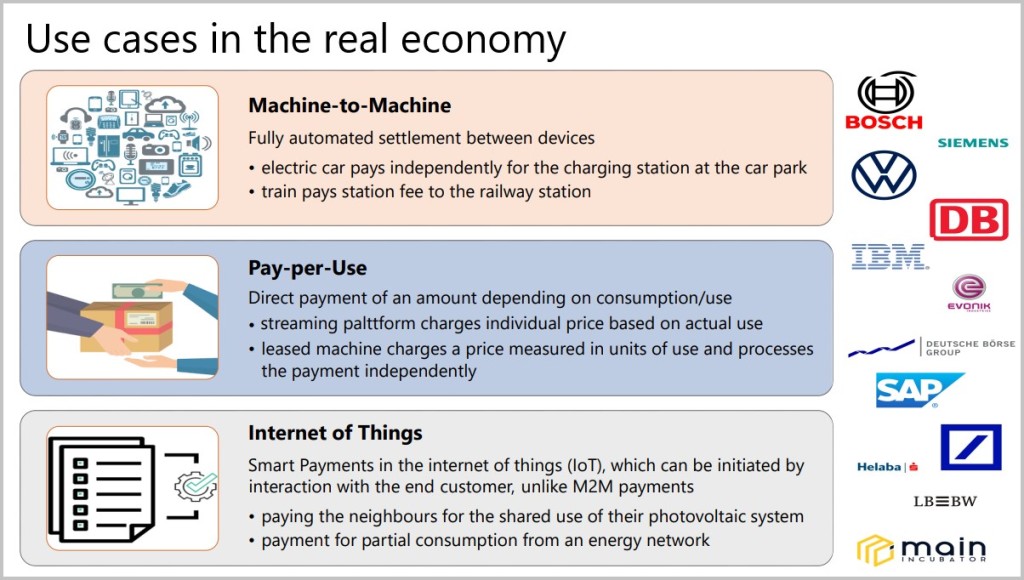
This objective cannot be realized with the existing payment processing system of the European Central Bank (ECB) due to compatibility problems.
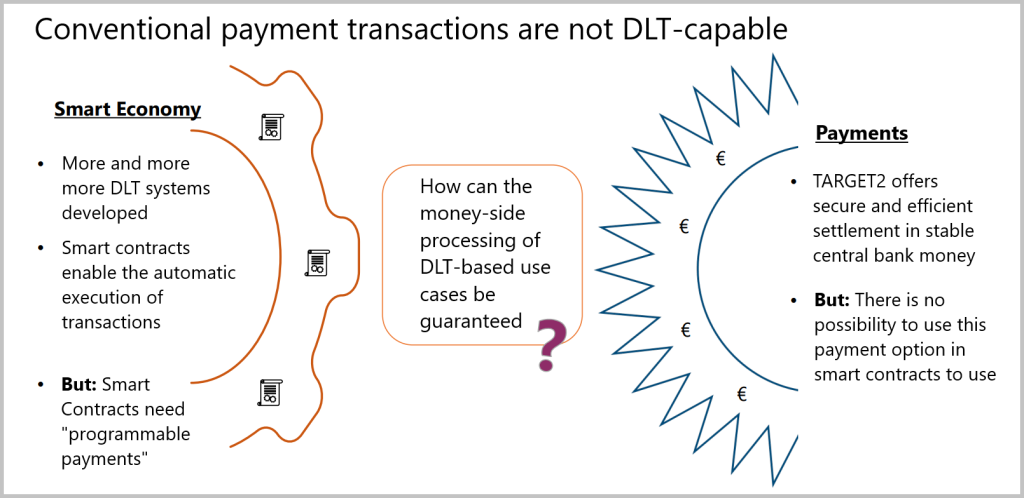
TARGET stands for „Trans-European Automated Real-time Gross Settlement Express Transfer System” and is the payment settlement system of the European Central Bank (ECB). It is the main instrument for settling euro payments within the Eurosystem, the framework in which monetary policy is implemented for the euro area.
Essentially, TARGET is a system that enables commercial banks to process payments among themselves in real-time and in euros. It facilitates the efficient settlement of payments between banks in the euro area, catering to both their own transactions and those of their customers.
The TARGET system comprises both the so-called TARGET2 mechanism for the settlement of large-value payments and the TARGET2-Securities (T2S) mechanism for the settlement of securities transactions.
For most people, the TARGET system is not directly relevant in everyday life as it is primarily used by banks. However, it plays a crucial role in the stability and efficiency of the financial system in the euro area by providing a secure and rapid mechanism for the exchange of euro payments between banks.
The Deutsche Bundesbank is examining two possible solutions. One option is to offer the wholesale CBDC in tokenized form directly on the DLT network on which the smart contract is executed.
Looking back at the discussions in Chapter 3.3., it’s recalled that a token in the world of blockchain is a digital unit with various functions. It can serve as a cryptocurrency, represent digital versions of fiat currencies on blockchain platforms, and be used for transactions. In Chapter 3.6, it was explained how a stablecoin is supported as a token on various blockchains. In this scenario, the tokenized Digital Euro behaves similarly to a „stablecoin” and is used for transactions on the same DLT network where the respective smart contract is executed. However, from today’s perspective, the practical implementation of this solution appears to be extremely challenging for the central bank.
The second option is to securely link the central bank money to the DLT network on which the smart contract is executed via an interface that has yet to be defined. This approach is similar to the logic described in Chapter 3.8.1. Smart contracts are contracts that are based on and dependent on data. Smart contracts and Dapps that run on a blockchain can only directly access data that is available on the blockchain. In the blockchain context, oracle services are external services or protocols that connect smart contracts with data or information from the real world. Since smart contracts on blockchain platforms cannot directly access external data sources, oracle services are required to bridge this gap. Oracle services act as an intermediary between the blockchain and external data sources such as APIs, IoT devices, traditional databases or other blockchain networks. They collect and deliver real-time data or events to smart contracts so that they can automatically execute actions based on this data.
This approach leverages the existing financial market infrastructure and is considered by the Bundesbank to be low-risk and quickly implementable. The financial market infrastructure (FMI) operates parallel to distributed ledger or blockchain networks, where tokenized assets are traded through smart contracts. The exchange of information between the DLT/blockchain network and the FMI (e.g., Bank A / Bank B) takes place via a so-called trigger interface. This synchronizes events between the blockchain and the real world. This trigger interface acts as an oracle with respect to the DLT/blockchain network.
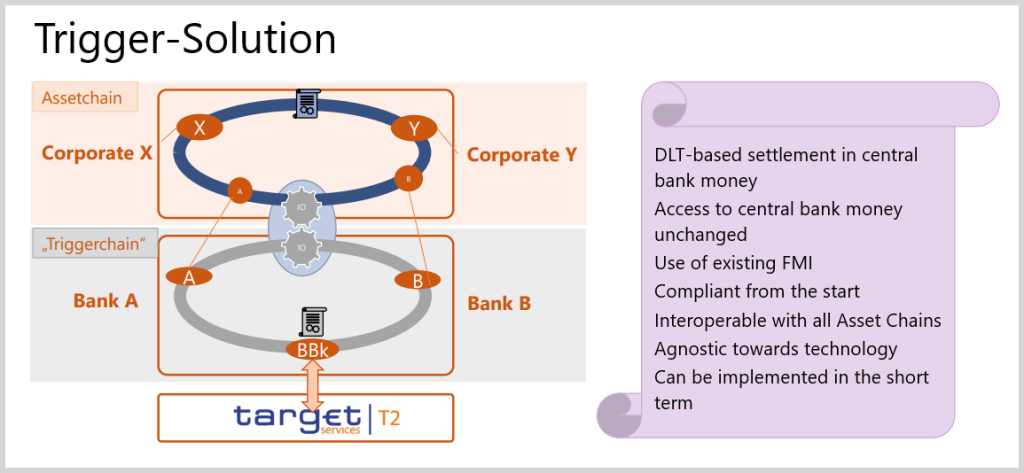
A trigger is a specific condition or event that initiates a predefined response in a financial product or a risk management system.
An asset is an economic value or resource that provides a benefit or a claim to future benefit for a company, an individual, or an organization. Assets can take various forms and are often used in different contexts, including finance, economics, and accounting. Here are some examples of different types of assets that may play a role in the example described above:
Tangible assets: These are physical assets that have a material value and can be used for the production of goods and services. Examples include land, buildings, machinery, equipment, vehicles, and inventory.
Intangible assets: These include non-physical but still valuable assets that are based on intellectual property or represent other non-physical rights. Examples include patents, copyrights, trademarks, licenses, software, trade secrets, and customer relationships.
Natural assets: These refer to natural resources such as land, water, air, minerals, oil, gas, and renewable energies that have economic value and can be used for the production and consumption of goods and services.
Assets play an important role in the valuation of companies, asset allocation, accounting, and financial planning. They are crucial for value creation and the success of organizations and serve as the foundation for investments, lending, and risk management.
The motto of the Deutsche Bundesbank is „Natura non facit saltum”. This literally translates to „Nature makes no leap”. This phrase originates from biology and refers to the notion that changes in nature occur gradually and step by step, rather than suddenly and abruptly. It emphasizes the idea of continuity and gradual development in natural processes and systems.
This logic is only partially reflected in the ECB article „Central bank money settlement of wholesale transactions in the face of technological innovation” from August 2023. There, one can read the following:
„The Eurosystem is analysing the potential impact of emerging technologies, including distributed ledger technology (DLT), on the settlement of wholesale financial transactions.
The majority of market stakeholders surveyed by the Eurosystem expect a significant uptake of DLT for wholesale payments and securities settlement, with an indicative time horizon of between five and ten years.
Many market stakeholders state that, in the absence of a DLT-compatible central bank money settlement solution, they would look for alternatives. In such a situation, market stakeholders may consider using alternative settlement assets, such as commercial bank money or stablecoins. Such alternatives would not provide the same level of safety as central bank money. A partial move from central bank money to other settlement assets could also increase liquidity fragmentation and have adverse implications for financial stability.
At the same time, some market stakeholders argue that the speed of DLT adoption, if not its success, might to some extent depend on the involvement of the central banking community. The ability to settle transactions in central bank money could be a requirement for certain market participants, preventing them from adopting DLT as long as a suitable central bank money settlement solution is not in place. In addition, central bank involvement could be perceived as support for DLT as an innovation in financial services.
Should the use of DLTs become more prevalent for wholesale financial transactions, possible Eurosystem responses could include enabling market DLT platforms to interact smoothly with Eurosystem infrastructures based on existing technology, or making central bank money available in a new form that can be recorded and transferred on a DLT platform. These responses are not mutually exclusive.
These new solutions may, but need not, involve the provision of central bank money in the form of DLT tokens.
The provision of any new Eurosystem solution for the central bank money settlement of DLT-based transactions must not come at the expense of the Eurosystem’s control over the central bank money it issues.“
The ECB has started to analyze and test four conceptual solutions.
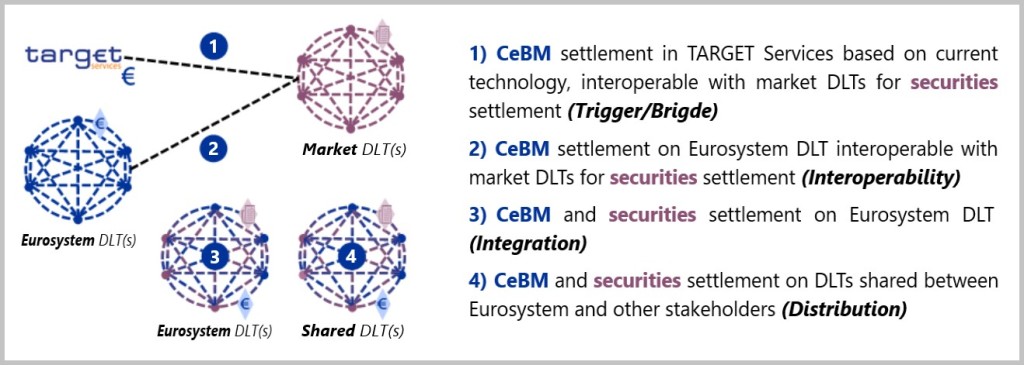
Notes: Blue lines, dots and icons represent central bank money (CeBM). Purple lines, dots and icons represent securities.
The first option (1) uses the existing financial market infrastructure (see Fig. 41). The second option (2) relies on a separate Distributed Ledger Technology (DLT) network that works with tokenized central bank money and is connected via an „oracle” interface to the external DLT network on which the smart contract is executed. Options (3) and (4) rely on a „unified” ledger where CBDC and security tokens are directly connected to the smart contract. The difference between the options lies in who operates the DLT network.
Compared to the Deutsche Bundesbank, the European Central Bank (ECB) is taking a more proactive approach to evaluating possible solutions.
Conclusion:
Over the next 10 years, the deployment and utilization of DLT platforms will significantly increase in both the economy and the financial sector. CBDC will increasingly be integrated as part of smart contracts running on DLT platforms. In the short to medium term, this integration will occur via an „Oracle-like” interface between the existing financial market infrastructure of central banks and external DLT platforms (trigger solution). In the medium to long term, the European Central Bank (ECB) may additionally introduce its own DLT platform and provide a central bank money (Digital Euro) token to enable connectivity with smart contracts.
It is important to note that the DLT platforms used in the real economy and the financial sector are not identical to the blockchain platforms in the cryptocurrency ecosystem. They are primarily „permissioned” or „centralized” DLT systems. In this type of DLT/blockchain, the participants or nodes operating the network and validating transactions are not open to everyone but are controlled through specific permissions.
Unlike the „permissionless” or „decentralized” blockchain, as used, for example, in Bitcoin or Ethereum, where anyone can participate in the network without restrictions, a permissioned or centralized blockchain requires authorization or permission to operate nodes in the network and validate transactions.
In a permissioned blockchain network, permissions can vary depending on the requirements and agreements of the participants. For example, a company or organization can establish a permissioned blockchain network where only selected parties have access to conduct transactions and validate blocks. This type of blockchain is often used in private or enterprise-specific applications where data privacy and control over the network are important.
In this case, the primary focus is on increasing efficiency and reducing overhead, especially in interbank transactions, securities settlement, and cross-border transactions, as well as improving transparency and control over the actions of authorized participants. It’s less about a high degree of openness or true decentralization.
4.2. Commercial Bank Money Token (CBMT) – Those who do not go with the times, perish with time
With the introduction of tokenized wholesale CBDC in the existing fiat banking system, changes in commercial bank money are expected to occur. On one hand, commercial banks are expected to ensure that commercial bank money can be converted into central bank money at a 1:1 ratio at all times. On the other hand, the number of traditional corporate clients undergoing digital transformation and becoming part of the new „Smart Economy” is expected to increase.
The term Smart Economy refers to an economy supported by the use of modern information and communication technologies (ICT) as well as innovative technologies such as blockchain, artificial intelligence (AI), and the Internet of Things (IoT). These technologies are utilized to make processes more efficient, transparent, secure, and interoperable.
In a „Smart Economy”, businesses and governments utilize digital technologies to increase efficiency and productivity, offer innovative services, and develop new business models. This can include the use of big data analysis, cloud computing, the Internet of Things (IoT), and machine learning to create intelligent solutions for various industries such as healthcare, education, transportation, energy, and finance.
In short, the „Smart Economy” refers to an economy characterized by the intelligent utilization of digital technologies and data to promote growth, innovation, and quality of life.
To meet the new requirements, existing commercial bank money needs to adapt to the technologies of Industry 4.0. This enables it to become an integral part of industrial value chains and leverage the potential of technology in the banking sector. This new technological representation of commercial bank money is called „Commercial Bank Money Token” (CBMT). A CBMT still represents commercial bank money with all its characteristics and services offered by banks. However, it can also enable new and additional functionalities by leveraging Distributed Ledger Technology (DLT).
The Committee of German Banking Industry (Deutsche Kreditwirtschaft) confirmed the necessity of introducing Commercial Bank Money Tokens (CBMT) in its „Working Paper on Commercial Bank Money Token” in March 2023 and presented a draft for the design and implementation of CBMTs.
The goal of commercial banks is to offer financial services to their customers (businesses and individuals) based on smart contracts. The basic idea is that customers of commercial banks can convert a portion of their electronic account balances into tokenized form to conduct payment transactions within the framework of smart contracts. The transfer of balances between the traditional electronic form and the tokenized form should be transparent and at a 1:1 ratio. A detailed description of this topic can be found in the aforementioned working paper.
In the position paper „The digital euro: Background information and assessment of recent discussions. Reviewing of the ECB’s design principles for a digital euro and their implications for our dual monetary system” of June 2023, the German Banking Industry Committee summarizes the types of money in the monetary system of the future as follows:

In the new monetary system, all forms of money currently available in the Fiat system will have a digital twin. This is in line with the ideas of the Bank for International Settlements (BIS).
Blueprint for the future monetary system: improving the old, enabling the new
The Bank for International Settlements (BIS) is often referred to as the „bank of central banks”. If you want to describe the role of the BIS metaphorically, you could see it as a kind of central coordinator for all central banks. It is therefore useful to take a closer look at the BIS’s ideas about the future monetary system. This short video message from June 2023 describes the BIS vision on this topic very clearly.
The aim of BIS is to establish a unified ledger. A unified ledger refers to a single database or accounting system that is managed by a central authority and can be shared by different parties. The unified ledger is intended to be a programmable platform on which money and assets are digitally represented as tokens. According to BIS, a unified ledger with CBDCs can facilitate the linking of different elements of the financial system by storing central bank money in the same place as other tokenized claims. This allows complex transactions with tokenized money and assets to be automated without the need to reconcile individual steps separately between different databases, as all the necessary elements are stored in a unified database.
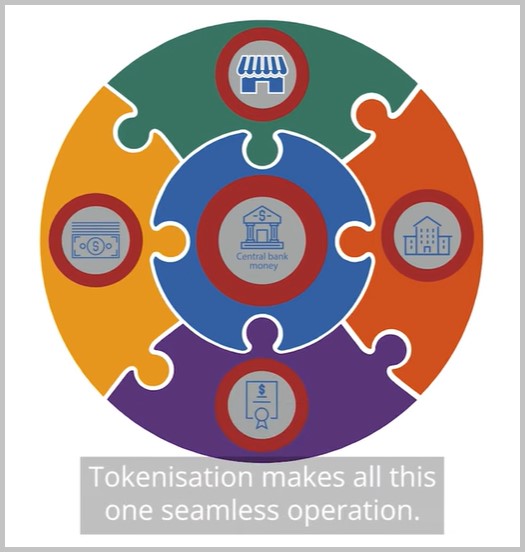
This vision is reflected in the ECB’s proposed solutions – Option 3 und Option 4 (see Fig. 41).
A token in the BIS world consists of two basic layers: Information about the „asset” (e.g. unique identifier, owner, custodian, origin, value, etc.) and rules (what the asset can and cannot do, e.g. for use in smart contracts).
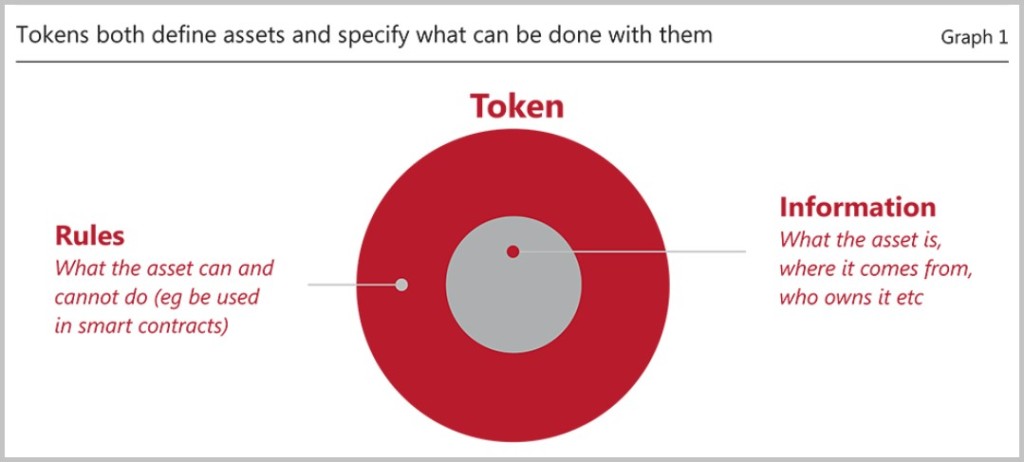
The term „asset” has already been explained in connection with Fig. 40. In addition to the asset types listed there, the BIS definition also includes financial assets.
Financial assets: These include assets that have a monetary value and can be traded on the financial markets. Examples include cash, bank deposits, shares, bonds, investment funds, derivatives and other financial instruments.
The process of tokenizing such assets is carried out using so-called ramps. These ramps define a link between assets in traditional databases and their digital versions (see Figure 45). The assets in the traditional database are „locked” and serve as security for the digital tokens that are issued on the programmable platform. This ensures that the transfer of the digital tokens also guarantees the transfer of the real assets. So if you own a token, you also own the real asset it represents.

From the perspective of the Bank for International Settlements (BIS), the unified ledger consists of two main areas: the data environment and the execution environment. Specific rules, standards, and governance apply in these areas. The data environment hosts money, assets, and information that are either internal or external to the ledger. Each of these elements is divided into partitions that govern ownership or access. The execution environment carries out operations that affect these elements, either directly by users or through smart contracts (see Figure 46).

The term „governance” refers to the way in which organizations or systems are directed, managed and controlled. It encompasses the defined rules, procedures, guidelines and mechanisms designed to ensure that an organization or system operates effectively, transparently, responsibly and in the best interests of all stakeholders.
In a broader context, governance can also describe the way in which decisions are made, resources are managed and responsibilities are assigned. This can extend to different levels, including governance at the national or international level, corporate governance in companies or organizations, and self-governance in communities or groups.
Good governance often includes characteristics such as accountability, transparency, participation, integrity and efficiency. It is about ensuring that decisions are made fairly and in line with the goals and values of the organization and that the interests of all stakeholders are adequately considered. In companies, strong governance can increase trustworthiness, reduce the risk of misconduct and promote long-term growth and sustainability.
An important question concerns the scope of the main ledger. According to the Bank for International Settlements (BIS), the concept of a unified main ledger does not preclude the existence of separate ledgers for different use cases. However, the BIS assumes that in practice, it will initially likely be applied to specific applications where the immediate benefits are most evident. For example, one ledger could aim to improve securities settlement and involve only relevant parties, while another could focus on trade finance, such as in the shipping industry. Over time, the scope of the main ledger could expand through the inclusion of additional assets and companies. Ultimately, the expansion of the main ledger will be influenced by the specific needs and constraints of individual countries.
Natura non facit saltum – Nature does not make a leap. However, nature is constantly changing.
Advancing global connectivity through technologies such as 5G, 6G and the Internet of Things (IoT), together with the introduction of ever more powerful technologies that are increasingly based on AI algorithms, is gradually changing various aspects of our lives. The motto „faster, further, higher” is driving this change and leading to a transformation of the economy into a „smart economy”, cities into „smart cities”, real estate into „smart buildings/homes” and cars into „smart cars”. This comprehensive „smartness” makes it possible to incorporate more and more assets into the data environment of a uniform ledger and to apply corresponding governance mechanisms as required.
There are some parallels between the concept of the „Unified Ledger” proposed by the BIS and the Ethereum world (Chapter 3.8.). In both cases, users interact in a programmable environment with smart contracts to execute transactions using tokens that meet predefined conditions. When these conditions are met, the smart contract automatically executes the corresponding actions in the Ethereum blockchain.
While Ethereum emphasizes the principle of „Code is Law”, the BIS speaks of governance. The Ethereum Foundation describes Ethereum as a protocol for human coordination. The unified ledger is promoted as a perfect foundation for seamless operations with assets.
The interaction of the Unified Ledger with external information still resembles the approach of Chainlink (Chapter 3.8.1.). However, a significant difference lies in the fact that BIS, ECB, and similar institutions employ centralized permissioned architectures, which entail certain risks.
Conclusion:
Tokenization will encompass not only wholesale CBDC but also commercial bank money. As a result, the issue will concern not only large financial institutions but also the general public. It is likely that this will initially be applied in Business-to-Business (B2B) transactions and then seamlessly reach the Business-to-Customer (B2C) environment.
The term Business-to-Business (B2B) refers to transactions that take place between two companies. For example, if a company buys computer hardware from another company, this would be a B2B transaction.
The term Business-to-Consumer (B2C) refers to transactions in which a company sells products or services directly to consumers. For example, if you buy a pair of shoes online from a retailer, this is a B2C transaction.
In simple terms, B2B refers to transactions between businesses, while B2C refers to transactions between a business and a consumer.
In the document „Blueprint for the future monetary system: improving the old, enabling the new”, the BIS comments on the topic of Retail-CBDS as follows:
„Enhanced digital representations of central bank money could include a retail variant open to use by ordinary users. A retail CBDC is a digital version of physical cash that can be used by households and firms for everyday transactions. By providing the public with a ready way to convert alternative private digital monies into digital cash, i.e. a direct link to the sovereign unit of account in digital form, the central bank would further support singleness.”
4.3. Retail-CBDC – Heaven Is a Place on Earth
Although retail CBDC represents only a part of the future tokenized financial system, it is at the center of attention and the subject of controversial discussions. Consumers fear the disappearance of cash, while banks are concerned about their business models and ultimately the financing of the real economy.
Nowadays, most people use cash and digital commercial bank money, also known as bank money, for the exchange of goods and services. They are very familiar with these two forms of money. Changing their behavior and habits in handling money will not be easy.
Broad public support is essential for the success of the CBDC. Consumers and retailers will ultimately be the end users. CBDC will not succeed if they are not convinced of its benefits. Educating the public about the pros and cons of CBDC will be critical to getting all stakeholders involved.
Although the preparation and trial phase of the European Central Bank (ECB) will only be completed in the coming years, the promotional campaign is slowly gaining momentum. Some of the arguments the ECB uses to convince the public of the digital euro are summarized in the promotional film „The Digital Euro – Easy, Safe, Fast, Reliable”.
Cash, commercial bank money, and the digital euro (after its introduction) fulfill the basic functions of money as legal tender: they serve as a store of value, a medium of exchange, and a unit of account. For these forms of money to be accepted by a broad population, they must also possess important characteristics such as privacy, accessibility, security, convenience, ease of use and cost efficiency. It is important to bear in mind that trust in the stability of money is crucial. However, this trust can quickly erode, especially in times of economic or political instability.
The success of the digital euro as a retail CBDC depends on how it positions itself in relation to cash and commercial bank money, taking into account the aforementioned additional characteristics. Below, the three forms of money are compared from this perspective, starting with the current status quo.

Physical cash vs. digital private bank money
– a comparison from the end user’s perspective –
„Never touch a running system.“
Data protection / Privacy:
Digital money and the associated transactions leave digital traces. Relevant information is collected by the respective banks, credit card companies, and private payment system operators. Authorities also have easy access to this data, especially when investigating suspected cases of tax evasion, money laundering, terrorism financing, or other illegal activities in accordance with applicable laws. Therefore, it is not possible to achieve the same level of anonymity as with cash.
On the other hand, the use of cash for financial transactions is increasingly restricted by law in many countries. According to current EU regulations, cash payments are only permitted up to an amount of 10,000 euros. For cash transactions between 3,000 and 10,000 euros, the new regulation requires proof of identity as well as proof of the origin of the money. This data must be recorded and stored by merchants and institutions.
In normal times, many people have no problem sacrificing their privacy to combat crime and terrorism. However, let’s recall the events in Hong Kong in 2019, when political protesters lined up to pay for their subway tickets in cash. The protesters expressed concerns that their card data could be traced and used as evidence against them if they were prosecuted by the police—similar to what happened to leading figures of the pro-democracy Umbrella Movement in 2014. This demonstrates that people in authoritarian regimes can suddenly recognize the importance of cash.

Accessibility
Cash is extremely easy to obtain. To have it, you simply need to find someone willing to give it to you.
However, if you want to access digital money, you will need a bank card. To do this, you will need to convince the bank that you are who you say you are by showing your ID and assuring them that you will not use the card for illegal purposes. For most of you, this may not be a problem, but research data shows that in 2021, around 4% of the population in the EU still did not have a bank account. In emerging and developing countries, this percentage is significantly higher.
What is particularly worrying is that there have been a number of cases where people have lost their bank accounts. One example of this is in the UK, where controversial politician Nigel Farage temporarily lost his bank account because his ‚values‘ did not match those of the bank. In Canada, private banks were pressured by the government to freeze the accounts of truck drivers protesting against the Covid-19 vaccination.
Although bank accounts are accessible to most, they remain out of reach for many people and there is a real risk of losing access to them in certain circumstances.

Security
In terms of safety, there is a tie.
On the one hand, carrying a lot of cash carries the risk of theft or loss. On the other hand, bank fraud is also a potential threat.
However, when a financial crisis occurs, people often realize once again that digital private bank money is ultimately just a promise to pay physical central bank money.
Cash is issued directly by the central bank and is physically available. It is backed by the authority of the central bank. Public confidence in the central bank and the stability of the currency play an important role in backing cash. If the central bank is considered trustworthy and the currency is stable, cash is automatically accepted and acquires an intrinsic value.
The security of private digital money heavily depends on the financial stability of commercial banks. As described in Chapter 2.2.1., banks lend out a large portion of their customers‘ deposits to other customers and keep only a fraction of these deposits available for potential withdrawals (minimum reserve). To protect a substantial portion of these deposits in the event of a bank failure, banks contribute to a safeguard fund, also known as a deposit insurance system. Following the financial crisis of 2007-2008, only certain minimum standards were established at the EU level, such as the protection of deposits up to €100,000 per bank customer.
In times of crisis, cash can serve as a secure emergency reserve, while private digital money depends on the liquidity of banks.

Convenience
Digitalization has revolutionized payment processing and will continue to do so in the future. Today’s payment methods are vastly different from a decade ago. With just one device or app, you can now make purchases on your watch while also using an app to split the cost of dinner with your date – all before you’ve even left the table. No more counting money or worrying about change. Carrying a bulky wallet or making regular trips to the ATM is also a thing of the past. As a merchant, accepting digital payments makes your administration much easier and saves you a trip to the bank to deposit cash receipts.
The implementation of social distancing, lockdowns and the fear of potential virus transmission via physical cash during the pandemic have further boosted digital transactions and payments. The pandemic has accelerated the process of digitalization in all industries worldwide, which in turn has encouraged the spread of cashless payments. This development has increased the acceptance of electronic payments by merchants to facilitate e-commerce and contactless exchanges.
In 2021, physical cash transactions accounted for 18% of POS transactions worldwide and are expected to fall to 10% by 2025. By region, the share of cash in 2021 was 44% in the Middle East and Africa (MEA), 36% in Latin America, 26% in Europe, 16% in Asia-Pacific and 11% in North America. A decline in cash usage is expected in all regions by 2025, for example to 31 % in MEA, 24 % in Latin America, 17 % in Europe, 8 % in Asia-Pacific and 6 % in North America. (Fig. 47).
POS stands for „Point of Sale”. A POS transaction refers to a financial transaction that takes place at a physical point of sale, such as at the checkout of a store or at a sales stand.


Ease of use / e-Commerce
Online retail is booming, and not just since the start of the coronavirus pandemic. In 2023, three quarters (75%) of 16- to 74-year-olds in the EU said they had already shopped online. Online purchases were particularly widespread in the Netherlands (95%), Denmark (94%) and Sweden (91%). Germany came eighth in the EU ranking with 82%.
In order to benefit from the advantages of online commerce, consumers have a variety of payment methods to choose from. The most common payment methods for e-commerce are shown in the illustration.

With the rise of e-commerce, it is becoming increasingly difficult for cash, as it is practically impossible to use cash for online purchases.

Cost efficiency
As a consumer, this aspect may seem unimportant to you, as both digital payments and cash transactions appear to be free of charge at first glance. However, there are costs and inefficiencies associated with the use of cash within an economy. This includes the need for careful handling and management, secure transportation, security measures and the provision of equipment or personnel to count the money. It also requires continuous investment in security measures to protect against counterfeiting, which in turn leads to additional costs.
In contrast, with each card payment made by a customer, a merchant pays a small fee to banks and card companies, which is factored into the pricing of their products or services.

After comparing the two traditional forms of money, the following conclusion can be drawn:
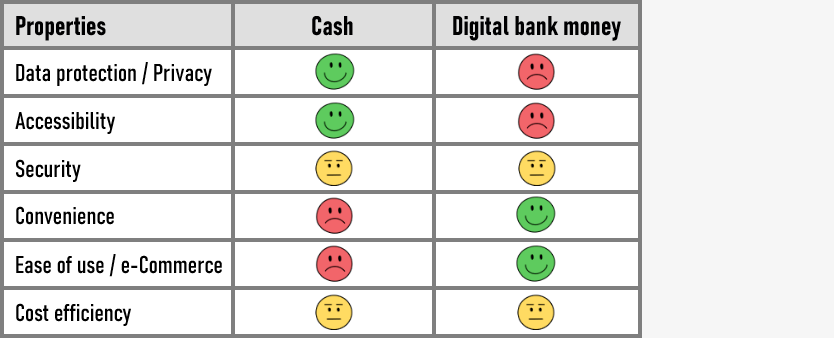
In summary, it can be noted that both traditional forms of money have their advantages and disadvantages, and neither of them is perfect.

Retail-CBDC – Advantages and potential risks
In order to alleviate public concerns about the introduction of CBDC and promote acceptance of this new form of money, it is crucial to publicly discuss both the benefits and the potential risks. How could such a discussion be framed from the perspective of CBDC proponents?
Data protection / Privacy
Unlike physical transactions with bills and coins, digital transactions leave digital footprints that are traceable and indelible. One characteristic of physical cash is its complete anonymity. There is no record of the transaction history. This is an indisputable fact.
Although most citizens today have no problem with commercial banks, payment service providers and other private payment providers such as Visa, Mastercard or PayPal accessing their transaction data, privacy and data protection concerns regarding CBDC are clearly pronounced. Private individuals fear that the state has access to sensitive and personal information about transactions compared to the private sector. One explanation for this is that the impact of private companies could be limited or harmless, such as further advertising on their devices. In contrast, the consequences for the state could be more serious. The fears could also be due to an „innate” or „acquired” distrust of governments that hold a large amount of data on citizens, leading to concerns about state surveillance and the maxim „Big Brother is watching you”.
Most people often ignore the fact that in a digital economy, the state already has access to data from private companies such as commercial banks and payment service providers. This is usually for a variety of reasons, including monitoring financial transactions to combat money laundering and terrorist financing, enforcing tax laws and maintaining financial stability. Access to such data is formally regulated by data protection laws and policies to protect the privacy of citizens.
However, the technology behind CBDC allows for a much deeper form of surveillance. An insightful comment on this matter comes from Augustin Carstens, the General Manager of the Bank for International Settlements (BIS):
Wouldn’t such a statement at least give you pause for thought? To alleviate concerns about government surveillance, it is the role of the authorities to reassure the public that adequate regulations and controls are in place. In this context, international organizations such as the OECD play an important role. The OECD document entitled „Central Bank Digital Currencies (CBDCs) and democratic values” contains some relevant statements on this topic.
„One of the risks posed by CBDCs for society is their potential use as surveillance tools, given potential access to heightened levels of information about users, including transaction and account level information. At the extreme, CBDCs could give governments the ability to monitor and track all transaction and other financial activity details of users, and also the possibility to exert greater control over private transactions. Authorities could unjustly censor users and transactions without due process or recourse.
Moreover, in a scenario in which CBDCs are used for largescale control of monetary transactions, CBDCs could become an instrument of control and social profiling, mbiased and discriminatory treatment of users and possible human rights abuse.“
The OECD is an international organization with 38 member states that are committed to democracy and a market economy. Its members include many EU countries, the USA, Canada, the UK, Japan and Australia. The document emphasizes not only understanding the risks of introducing CBDCs, but also setting clear guidelines to ensure that democratic values are taken into account in the design and implementation of CBDCs. There are four main areas to which particular attention is paid: (i) Civil liberties and human rights; (ii) Equity: availability, accessibility and affordability; (iii) Privacy and integrity; (iv) Trust: Security, transparency, operational resilience and protection of the aforementioned values.

The OECD considers data protection as follows:
„In terms of privacy options, the lowest degree of privacy would involve a design wherein all onboarding/KYC and transaction data are visible to the central bank. The second lowest degree of privacy would involve transparency and visibility of the above data to the intermediary only. On the other end of the spectrum, no data is visible to any third party or the central bank itself, i.e., full anonymity, which is not a desirable feature, as this would make it impossible to control circulation and to prevent money laundering. It would also impede regulation and enforcement activities. Instead, a model of ‘selective privacy’ involves a higher degree of privacy for low-value / low-risk payments, involving simplified checks (e.g., specific wallet with lower requirements during onboarding). Under this model, higher-value transactions would remain subject to standard controls.“
So far, none of the central banks conducting CBDC research have stated that they intend to collect and store detailed and specific data on citizens.
„When it comes to the central bank, we propose that we do not have access to personal data.“ Fabio Panetta, ECB 2023.
Instead, central banks have stated that the data collected will be gathered at an aggregated level to provide a better assessment and a more timely picture of the economic situation. The ECB report „Second update on the work of the digital euro scheme’s Rulebook Development Group” of January 2024 confirmed that the onboarding of end users of the digital euro will take place via supervised intermediaries. These intermediaries, mainly commercial banks, will also be responsible for the provision of Digital Euro Account Numbers (DEAN), user interfaces and alias registration. The collection of personal data will essentially not differ much from the procedure already used by commercial banks.
Regardless of whether terms such as „selective privacy” or „pseudonymity” are used, it will not be possible to achieve the complete anonymity of physical cash.
„A permissioned CBDC system, where participation is managed by a trusted entity or set of trusted entities, could yield better results in terms of privacy protection of sensitive financial data: transaction history is generally only viewable by a small number of trusted entities and kept private with respect to others.“ [OECD]
A counterargument from proponents of CBDC would be that the privacy and data protection of citizens can be better safeguarded compared to the current situation. They will emphasize the fact that private payment providers like Visa, Mastercard, or PayPal will not be able to access transaction data with CBDC to use it for cross-selling campaigns.
Let’s recall the context: Money = Value = Trust.
In the case of fiat currency, Trust = Trust in an institution/government.
With CBDC Trust = TRUST in an institution/government.

To what extent do you TRUST your government? That is the central question when it comes to privacy and data protection.

Accessibility
According to the European Central Bank’s report „Second update on the work of the digital euro scheme’s Rulebook Development Group” from January 2024, consumers will have to go through a similar process to that of digital private bank money to gain access to CBDC. Some of the onboarding steps will be automated and made more convenient and accessible to the public. Nevertheless, three essential components will be indispensable: identification (such as an ID card or digital ID), a digital wallet (for example as an app on a smartphone) and a bank account. In an interview, Nandan Nilekani, CEO of Infosys Technologies, explains this connection succinctly:
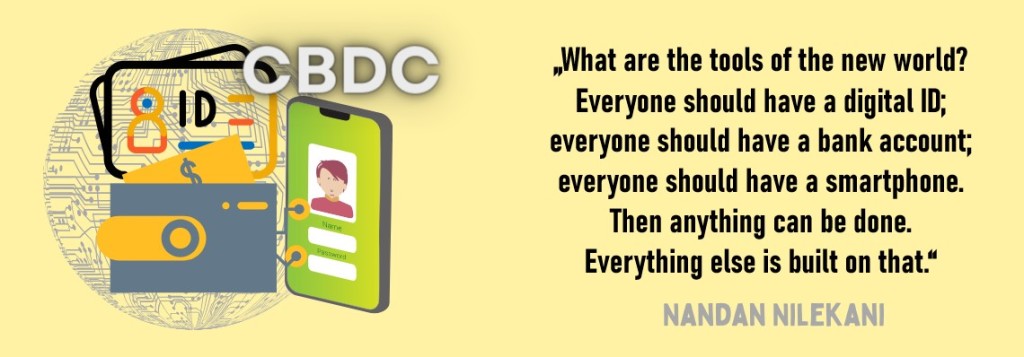
If you TRUST your government enough and equate accessibility with convenience, one might conclude that access to the CBDC can certainly be facilitated.

Security
Like cash, CBDC is also issued by central banks and backed by their authority, creating a new „safe asset” in digital form. CBDC therefore fundamentally competes directly with the private bank money of commercial banks.
If the role of commercial banks is seen as less important in the further development of the financial system, retail CBDC could be made more investment-like, for example by paying interest on the CBDC amounts of end consumers like a savings offer. This would have far-reaching implications for commercial banks, as their deposit business would be severely impacted in this scenario and their entire business model would be called into question. If commercial banks are to continue to play an important role, CBDC could be limited exclusively to cash-like functions. As commercial banks currently have direct contact with end users, it is mainly up to them to influence the overall acceptance and success of CBDC. Therefore, any central bank is unlikely to introduce a central bank digital currency against the resistance of commercial banks and will consider CBDC exclusively as an alternative to cash in the initial phase.
Another problem that can cause headaches for commercial banks is the so-called bank run scenario. A bank run occurs when a large number of people start withdrawing their deposits from a bank at the same time for fear that the bank may become insolvent. This can lead to financial difficulties or even the collapse of the bank, as it may not have enough liquid funds to cover all withdrawals (see also chapter 2.2.1.). In times of crisis, such a scenario could quickly become a reality. Instead of queuing in front of ATMs, after the introduction of CBDC, most people could convert their deposits at a commercial bank into the supposedly safer CBDC with a simple mouse click. To prevent this, central banks are likely to introduce a cap on CBDC holdings. In the eurozone, this limit will most likely not exceed EUR 3,000. According to the European Central Bank, transactions above the defined limit can be processed with the so-called waterfall function (waterfall or reverse waterfall) at the user’s request. Amounts above the limit are transferred either from or to the user’s commercial bank account.
In practice, this means that the digital EURO account is directly linked to the commercial bank account and is considered more as a minor extension. In this scenario, the benefits of a „safe asset” for the end consumer are significantly mitigated.

In terms of convenience and e-commerce, CBDC does not bring any significant innovations compared to digital private bank money.
However, transaction costs for both retailers and end consumers could be reduced by the elimination of private payment service providers such as Visa, Mastercard, or PayPal. New technological innovations like Distributed Ledger Technology (DLT), tokenization, and smart contracts could further decrease costs for domestic and especially international money transfers.
Therefore, the interim conclusion is as follows:

A proponent of CBDC might argue that compared to digital private bank money, privacy, accessibility, security, and cost structure are improved. A neutral observer might mainly recognize the cost benefits and begin to question how far their trust in the government extends.
Geopolitical advantages
Currently, the US dollar is used directly or indirectly in about 88% of all global foreign exchange transactions. This use of the dollar, together with dollarization in some countries and the fact that many central banks hold the dollar as a reserve currency, gives the US a lot of power, even outside its borders. For example, they can exert influence on other countries through sanctions and political pressure. Recent events, such as the war in Ukraine and the West’s reaction to exclude Russia from the financial system, have led many countries to take an interest in CBDC in order to be better protected in the future.
A functioning settlement system between any two central banks can ensure that economic activity can continue uninterrupted. Even if this system is more expensive than traditional channels, it can still be cheaper than the complicated network of banking relationships currently used to circumvent sanctions. Many countries looking to strengthen their own resilience will undoubtedly consider the importance of a reliable settlement system in the geopolitical landscape.
The increasing geopolitical instability worldwide has prompted the ECB to accelerate the testing of the conceptual solutions described earlier for the settlement of central bank money for wholesale transactions (Wholesale CBDC).
Although this aspect mainly concerns the development of wholesale CBDC, it is often used by proponents of retail CBDC as a convincing argument to emphasize the need for CBDC. Nothing unites more than an external enemy.
Programmability
In the previous chapters, it has been demonstrated that CBDC technology utilizes some key elements of technology from the crypto ecosystem. These include Distributed Ledger Technology, tokenization, and the use of Smart Contracts. This makes CBDC programmable, leading to various potential scenarios.
For example, expiry dates could be introduced for stimulus funds, as well as expenditure restrictions for specific locations or regions and limitations on the use for specific goods such as groceries. There could also be restrictions prohibiting the purchase of other items such as alcohol and cigarettes. Such scenarios fuel the arguments of CBDC skeptics.
At this point, once again, the connection between CBDC and democratic values is emphasized. In the document „Central Bank Digital Currencies (CBDCs) and democratic values”, the OECD addresses this issue as follows:
„Although programmability could enable government or central bank-initiated programmable money that works only in certain ways, this would work against policy objectives of providing uniform CBDCs to citizens and promoting user trust. Payments programmability on the other hand, controlled by the users, could provide enhanced functionality for users to set rules on their payments. In some cases, it is envisaged that Payment Interface Providers and External Service Interface Providers could implement such programmable functionalities themselves, but they would require user consent and not be at the issuer’s direction.“
The European Central Bank (ECB) distinguishes between two concepts: programmable money and programmable payments. With programmable money, conditions for the digital euro (as mentioned above) can be established. On the other hand, programmable payments refer to payments that can be automatically triggered when predefined conditions are met. In short, CBDC is a digital currency in electronic wallets used for transactions. Programmable payments concern the actions that can be performed with CBDC in electronic wallets.
The ECB has explicitly ruled out programmable money but advocates for programmable payments. According to the ECB, programmable payments can enhance user experience and increase payment efficiency. This occurs at the level of commercial banks and payment service providers (PSPs) and not at the central bank level. It requires user consent and is not mandatory.
Supporters of CBDC view programmable payments as the foundation for creating innovative financial services.
Only time will tell what lies behind these innovative financial services.
Some food for thought in this context can be found in the article „Rethinking the Rise of Global Central Bank Digital Currencies: A Policy Perspective” by Gengxuan et al.
The authors of this study explore how the combination of CBDC and Smart Contracts can directly influence fiscal policy. Compared to the impacts of CBDC as a medium of exchange, the impacts of CBDC as a policy tool are even more significant and complex.
Central banks traditionally employ a strategy called „Forward Guidance” to transparently communicate their future monetary policy plans. This communication concerns aspects such as the direction of interest rates or other monetary policy measures. The aim is to influence market expectations to steer economic outcomes such as investments, consumer confidence, or inflation. It is assumed that market participants will rationally respond to this information. However, the authors point out that most consumers, due to their cognitive abilities, only respond to this policy to a limited extent. Inflation expectations often do not factor into their spending and saving decisions.
The question is how CBDC, in conjunction with Smart Contracts, can be used to incentivize individuals and households to make decisions aligning with the objectives of the central bank. This combination could enable central banks to influence the decision-making process of individuals, which can be rational, bounded rational, or psychologically motivated. Through Smart Contract technology, the costs and benefits of certain decisions for households can be altered. CBDC, coupled with programmable payments, could thus serve as an instrument to enhance the impact of monetary policy at the micro level.
One potential application scenario could be tax reduction policy. If implemented via CBDC, the conditions of the tax reduction can be integrated into the Smart Contract. For example, it could be stipulated that the tax reduction must be used for consumption or investment purposes and not for debt repayment. Traditionally, tax incentives can influence consumption and investment behavior, but the benefits do not directly impact consumption and investment. Implementing conditional tax reductions through CBDC and Smart Contracts can directly affect consumption. Additionally, targeted tax reductions could be made for various consumer groups, such as low-income families, as they are particularly responsive to tax incentives.
Through CBDC, government purchases can be processed using Smart Contracts. Such payments can be tailored to political goals, such as supporting small and medium-sized enterprises (SMEs). Often, SMEs cannot directly benefit from targeted tax reductions or purchases, leading to an unequal distribution of political support. CBDC and Smart Contracts could amplify these effects by obligating companies to conduct more business with SMEs.
These are just a few examples of how retail CBDC could serve as an effective tool for implementing monetary policy measures and political goals at the individual level. This aligns with the concept of „reward and punishment” used in modern biopolitics. From the individual’s perspective, this type of governance appears as a kind of „good shepherd”, whose task is to promote the well-being of the people. The goal of this governmental technique is to encourage individuals to enhance their performance, strengths, and abilities to maximize their contribution to the society’s production apparatus. Through these regulatory methods, norms are established that differentiate between „normal” and „abnormal”. „Correction tools” are defined to help change individual behavior and shape the person as an integral part of the population.
Norming in the biopolitical context leads to two complementary biopolitical actions:
a) The promotion (inclusion) of those deemed worthy of promotion.
b) The exclusion (exclusion) of those considered unworthy of promotion.
More on this topic can be found here.
Conclusion:
The future development of the fiat financial system will be heavily influenced by technological elements that have been developed and tested in the crypto ecosystem. These include distributed ledger technology, tokenization, and smart contracts.
In the medium to long term, both wholesale CBDC and commercial bank money will be digitized in the form of tokens. Tokens represent assets, physical objects, or intangible values on a programmable platform. As a result, both CBDC and commercial bank money will increasingly be integrated into smart contracts. This will initially be implemented in business-to-business (B2B) transactions and later transition seamlessly into the business-to-customer (B2C) environment.
The introduction of retail CBDC aims to close the final gap in this tokenization process and be integrated into smart contracts as a digital version of physical cash.
In addition to optimizing and accelerating internal banking processes and transactions, this transformation of the financial system aims to increase the geopolitical resilience of states or groups of states. The introduction of CBDC is directly linked to the preservation and defense of democratic values in society.
The new infrastructure will enable central banks to collect aggregated data in order to obtain a more accurate picture of the economic situation. They could also use smart contracts to take prompt corrective action at both a macro and micro level. Implementation may vary depending on the democratic or authoritarian orientation of society. Therefore, trust in the government and its commitment to democratic values is particularly emphasized in this new constellation.
In any case, CBDC will serve as a powerful instrument of biopolitics in modern societies, enhancing the coordination of all market participants in line with the central bank’s objectives. Through the close connection between central bank and government policies, the implementation of certain political agendas will also be supported.
5. A glance into the future – Welcome to the tokenisation continuum
If you are still uncertain about the potential development of European society following the introduction of CBDC and tokenized money in line with democratic values, it is advisable to take a closer look at the future vision of the „Tokenise Europe 2025” initiative. This initiative was launched by the European Commission and the Association of German Banks and is supported by the consulting firm Roland Berger as well as more than 20 member organizations from various countries and industries to advance the tokenization of Europe.
The future of Europe is described as follows:
In 2030, we no longer „go online”, because being online is an integral part of life. Technology and digital services are embedded in our daily routines, our work, our lifestyle, 24 hours a day.
A DAY IN THE LIFE OF A TOKENISED EUROPE IN 2030
07:00
It’s getting warm outside. Simon is a European citizen and has a biunique digital identity token stored in his smart watch. Simon’s digital personal trainer receives fitness data from his smart watch while he is asleep. Simon’s tokenbased digital twin always calculates the best action for him to engage in next. The trainer creates a daily plan in line with Simon’s preferences and fitness condition. Today’s plan has already been sent to all his electronic devices before the alarm rings. A micro-payment to his digital personal trainer was made automatically even before Simon woke up. Since weather data has also been sent to his smart home and has been adjusted by his local sensor, the air-conditioning is activated. Simon gets some coins for data collected from his local sensor.
07:30
Time for breakfast! The refrigerator, aware of the weather and Simon’s fitness condition, will recommend that he eats light meals today. The refrigerator knows what is stored inside it and also knows Simon’s preferences (e.g. for organic food that is digitally certified by the producer via a digital token containing all information about production, transport and delivery). By combining this information with Simon’s digital ID and payment data, the refrigerator can reorder missing foods. Simon’s grocery supplier delivers the food to his door within 20 minutes.
08:00
Simon receives a suggestion from his electric transport provider: „Simon, you shouldn’t be walking the long way to the office in hot weather conditions. We recommend using an eco-friendly carpool. Please confirm the pre-booking we have made.” In 2030, all digital identities – those of people and machines alike – are stored in digital wallets. These wallets also include digital money, driving licences, insurance policies and details of the registered address etc. – in Simon’s case all in accordance with his personal preferences and the rules he himself has pre-defined as owner of the data. The electric car, which has recharged itself at the parking space overnight, is ready and waiting for him.
08:15
To ensure an optimal distribution of cars within the city, dynamic pricing modules calculate usage fees based on location and/or nearby events. After the car key has been sent to Simon’s smartphone as a digital twin, the usage fee is calculated in addition to the dynamic price-per-kilowatt-hour based on consumption. The insurance fee is payable via a separate insurance token and depending on his driving style. Today, he received a discount, because he is also the owner of a security token from the car sharing company, and today they paid a dividend.
08:30
Simon works in the logistics department of a textile company that manufactures its products outside Europe and has a global supply chain. In the days before tokenisation, global supply chains were challenging to manage because of the many suppliers, intermediaries and public authorities involved across many different countries – complexities that came on top of non-digital/paper processes, language barriers, legal differences and time-zone differences. In combination with digital contracts and transactions, tokenisation has vastly improved the transparency, safety and efficiency of such transactions.
09:00-17:00
From his office in Berlin, Simon can track every link in the production chain. Ms. Jin picks the cotton from a field in the Huang-Huai-Hai region and the cotton is delivered to the factory by Mr. Xiao. An embedded token contains information about which workers have worked on the product and been involved in transporting it by truck to the harbour and the ship etc. This is especially useful to ensure that sustainable and ethical production and transport standards have been fulfilled every step of the way. Since the contracts with the suppliers are defined as smart contracts in a distributed ledger technology network, all payments are automated. If the contractual requirements are met, the payment will automatically be booked from the company’s wallet while Simon is enjoying a coffee at the office. After making sure everything is fine with the transaction, Simon joins his business meeting, which takes place in a metaverse application.
17:00
At the end of his working day, Simon’s digital personal trainer reminds him to attend his sports class, which is also in the metaverse. His trainer, who lives in the USA, will be waiting for him, so both can have a digitally enabled training session as if they were in the same physical place.
20:00
After working out, Simon has dinner with Zeynep. The bill for the delicious dinner is sent directly to Simon’s wallet, where he chooses the tip amount and pays in digital euros. The wallet provider – his bank – sends him a notification every time a payment or other change is made in the wallet. Furthermore, his personal electronic wallet consists not only of means of payment, but also of a variety of tokenised assets: stocks, stablecoins, exchange traded funds (ETFs) and corporate bonds. Some of his friends even own fractions of classic cars, artworks, houses and other items in the same way. This is possible because, nowadays, previously illiquid asset classes, high-priced assets and expensive transactions can be digitally acquired and processed in small fractions at almost no transaction cost.
After arriving home, Simon has a last look at the latest news broadcast in the metaverse based on his self-defined preferences. He then calls it a day.
6. Epilogue
Does this future vision, developed by the European Commission and the Association of German Banks, align with your expectations? Do you aspire to lead a comparable everyday life to Simon’s?
If so, congratulations! You’re likely to experience an unconditional love story with CBDC and the associated system.
If this vision evokes mixed feelings for you, your relationship with CBDC and the associated system may be more of a love story with reservations. Despite the perceived benefits of the new system, you may hope for the government to demonstrate a strong understanding of democracy and mitigate or at least consider the potential drawbacks of the system.
History has taught us, however, that the understanding of democracy can evolve over time. It is influenced by various factors, including societal developments, political events, cultural changes, and individual experiences. For example, technological advancements, economic conditions, or political crises can impact the perception and interpretation of democracy. Media and political discourses can contribute to shifting perceptions and expectations regarding democracy over time.
If you reject the vision, you may still trust that the government will keep its promise that the digital euro will not replace cash, even though there is no mention of cash in the vision.
„Digitalization gives us the opportunity to shape democracy in a completely new way.”
Yuval Noah Harari, author of „Sapiens: A Brief History of Humankind
Sources (as of 25.05.2024)
 Dig Deeply